June 2026 | 1445 words | 6-minute read


The Invisible Race
Tata Communications revolutionizes Formula One’s global broadcasts by enabling near-instant transmission of race footage, audio, and data from circuits to viewers worldwide. Using a dedicated 100-gigabit fibre backbone, over 125 video feeds and 250 audio channels are delivered to the UK’s Biggin Hill centre with under 200-millisecond latency, allowing seamless live production and distribution to 180+ territories. Their remote production model, replacing satellite and on-site crews, has reduced trackside personnel by 90% and F1’s freight emissions by 34%, supporting sustainability goals. Tata’s empowered global teams ensure reliability, while ongoing collaboration drives innovation in immersive, data-rich fan experiences.
The Invisible Race
Tata Communications has revolutionized the global broadcast of Formula One (F1), enabling millions of fans to experience races like the 2025 Hungarian Grand Prix in real time, with less than 200 milliseconds of latency. When dramatic moments unfold on track, a vast technological infrastructure instantly captures and transmits over 125 live video feeds and 250 audio channels, alongside telemetry and data, from the race circuit’s Event Technology Centre to the F1 Media and Technology Centre at Biggin Hill, UK. This is made possible by Tata Communications’ dedicated 100-gigabit fibre backbone, designed specifically for F1, which supports remote production and instant global distribution to over 180 territories, reaching an average of 86 million viewers per race and a cumulative 2.06 billion audience annually.
Since becoming F1’s official Broadcast Connectivity Provider in 2012, Tata Communications has shifted the sport from satellite and on-site production to a scalable, IP-based, cloud-ready workflow. This transition has reduced trackside crews by 90% and cut F1’s travelling freight by 34%, significantly improving sustainability and supporting F1’s goal to be net zero carbon by 2030. Tata Communications’ distributed teams are empowered to resolve technical issues instantly, ensuring seamless broadcasts. The partnership continues to evolve, focusing on next-generation live media experiences, richer data analytics, and enhanced fan engagement. As F1 grows and technology advances, Tata Communications remains a constant, pushing the boundaries of live sports broadcasting and setting new standards for efficiency, sustainability, and innovation in global sports media.
The Invisible Race
Tata Communications has revolutionized Formula One’s (F1) global broadcasting, enabling millions of fans worldwide to experience races in real time. At the heart of this transformation is a sophisticated technological infrastructure that transmits live footage, audio, and vast amounts of technical data—such as lap times and car telemetry—from the circuit to viewers in less than a second. When Lando Norris wins the 2025 Hungarian Grand Prix by a fraction of a second, this moment is instantly captured by over 125 video feeds and 250 audio channels, including cockpit cameras and team radios. All this data is sent to the Event Technology Centre (ETC), organized, and transmitted via a dedicated 100-gigabit global fiber backbone to the Formula 1 Media and Technology Centre at Biggin Hill, UK, with latency under 200 milliseconds.
At Biggin Hill, production teams receive these feeds in real time, selecting camera angles, inserting graphics, and preparing the broadcast for distribution. The finished feed is then sent to broadcasters in over 180 territories, reaching an average of 86 million viewers per race and a cumulative audience of 2.06 billion per season. This seamless, near-instantaneous transmission ensures that fans everywhere witness the action as it happens, powered by a “race beneath the race” of data streams and fiber networks.
Tata Communications, the official Broadcast Connectivity Provider for F1 since 2012, pioneered a remote production model that replaced traditional satellite and on-site workflows. Initially, the partnership began with a simple 100 Mb internet line, but it has evolved into a complex, low-latency, edge-based platform supporting terabytes of data, software-defined networking, and Multi-Cloud Connect. Previously, broadcasting relied on massive trucks and hundreds of technicians at each race. Now, flexible IP-based networks and cloud-ready infrastructure allow most production roles—editing, directing, graphics—to operate centrally, reducing trackside crews by 90% and improving efficiency.
The engineering challenge is immense, given F1’s 24 races across continents. Tata Communications’ media backbone links every circuit to Biggin Hill, enabling producers thousands of kilometers away to switch camera angles and mix audio as if they were trackside. This shift allows richer, multi-angle coverage tailored for any device.
Remote production also advances sustainability. Transporting equipment and crews generated significant carbon emissions, but since Tata Communications introduced remote operations in 2020, F1’s traveling freight has reduced by 34%. This supports F1’s commitment to net zero carbon by 2030 and aligns with Tata Communications’ sustainability goals, making F1’s model a blueprint for future sports broadcasting.
Technical excellence is ensured by empowering distributed teams to resolve issues instantly, rather than relying on central approvals. This approach enables rapid responses to unpredictable challenges during races.
Looking ahead, Tata Communications and F1’s partnership is expanding digital capabilities. Innovations in cloud computing, edge networks, and immersive media promise richer content, enhanced data analytics, more audio languages, and fan-based commentary. As F1 evolves—with new teams, smarter cars, and fresh destinations—Tata Communications remains a constant, pushing the boundaries of sports broadcasting and delivering cutting-edge experiences to fans globally, invisibly powering the excitement behind every race.


- 0.5×
- 0.75×
- 1×
- 1.25×
- 1.5×


By less than a second, McLaren’s Lando Norris, the world champion, wins the 2025 Hungarian Grand Prix, holding off relentless pressure from his teammate Oscar Piastri, crossing the finish line after a dramatic final-lap chase in one of the most thrilling races in Formula One (F1) history.
In less than a second, a remarkable technological chain reaction begins that allows millions of fans across the planet to experience this showdown instantly.
In less than a second, the captured footage and audio are sent to the circuit’s Event Technology Centre (ETC), where they are organised and prepared for transmission. Alongside the video streams, vast amounts of technical information are also transmitted, such as lap times, car telemetry, and onboard camera feeds.
In less than a second, every movement, sound and data point is instantly captured and transmitted. From over 250 audio channels that record everything from engine notes and tyre squeals to team radio messages and commentary, to more than 125 video feeds around the track and inside the cars, including cockpit cameras mounted on the drivers’ helmets.
In less than a second — less than 200 milliseconds to be exact — the data travels thousands of kilometres from the ETC to the Formula 1 Media & Technology Centre at Biggin Hill in the United Kingdom, using a 100-gigabit, global, fibre backbone designed specifically for F1.
In less than a second, the race is produced for global television audiences. At Biggin Hill, production teams receive the incoming feeds in real time. They choose camera angles, insert graphics, analyse data and prepare the broadcast feed seen by viewers.
In less than a second, the world tunes in. Once the broadcast feed is ready, it is distributed to broadcasters from more than 180 territories globally, bringing the action from the track to screens everywhere. On average, 86 million viewers watch each race, contributing to a staggering 2.06 billion cumulative audience across the season.
In less than a second, billions of screens are lit, billions of hearts pumping. The moment that Norris laps Piastri on the track in a thrilling finish, is the exact moment you witness it on your screen.
The Race Beneath the Race
Powering your experience of the pinnacle of motorsport, is an invisible race of fibre networks, data streams and broadcast technology working at lightning speed so that fans everywhere can share the thrill of F1 in real time.
At the centre of it is Tata Communications, the official Broadcast Connectivity Provider for F1 since 2012. Over the past decade, the company has transformed the way live motorsport is produced and delivered, pioneering a remote production model that transmits enormous volumes of video data across continents with millisecond precision.
In the early days, the requirement was simple: reliable connectivity.
The result is one of the most advanced live sports broadcasting systems ever created.
The collaboration between Tata Communications and F1 began in relatively modest circumstances. In the early days, the requirement was simple: reliable connectivity.
Says Dhaval Ponda, Vice President and Global Head, Sports, Media and Entertainment, Tata Communications, “The partnership began with just a simple 100 Mb internet line and has now transformed into a complex, low-latency, edge-based video technology platform that supports over 125 live video feeds, terabytes of data, software-defined networking and Multi-Cloud Connect for F1 themselves and a host of F1 teams. Wherever you are watching a live F1 race, anywhere, on any screen, we make that possible.”
At that time, global broadcasting workflows were heavily dependent on satellites and on-site production crews. Massive broadcast trucks filled the paddock, and hundreds of technicians travelled from race to race to manage complex equipment.
But broadcast technology has changed dramatically since then.
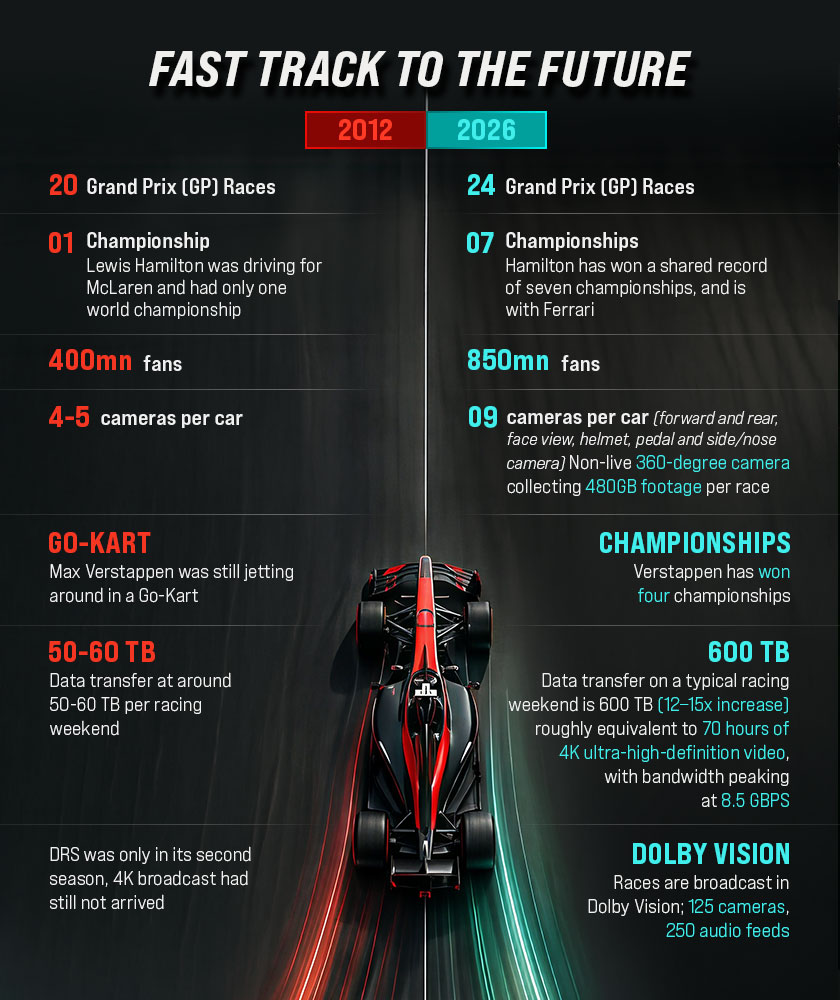
Streaming platforms emerged, audience expectations grew higher, and the scale of sports broadcasting expanded. Recognising the shift, Tata Communications and F1 began rethinking the entire broadcast architecture. Today, that single internet cable has evolved into a global network capable of handling enormous data flows every race weekend. (see box)
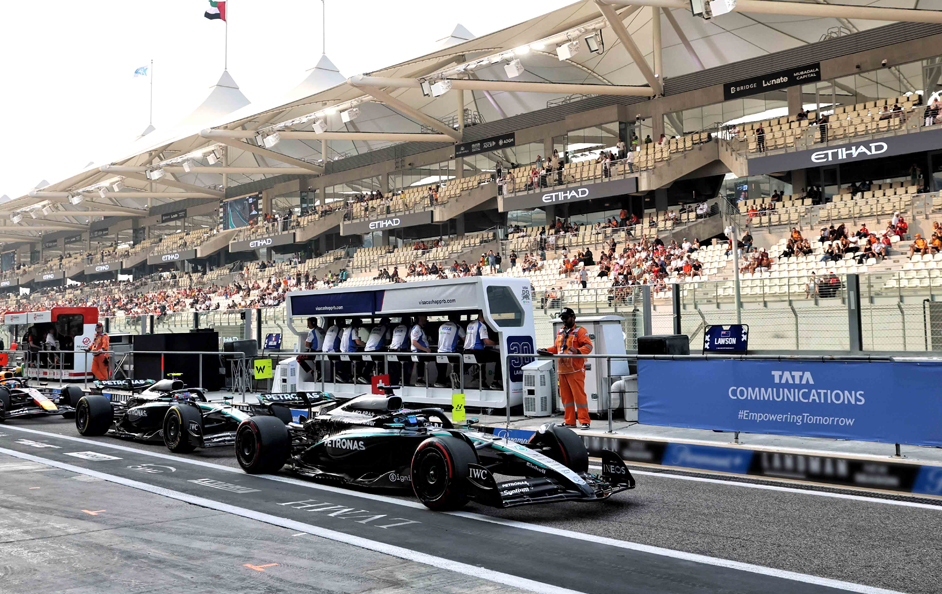
The scale is massive. Each race attracts around 86mn viewers, contributing to the sport’s total annual reach of more than 2.06bn people, according to Nielsen data. Delivering such a broadcast requires technology that operates with the precision of a race car.
The Engineering Challenge
Broadcasting a live sport is complex, but F1, with 24 races across continents, takes it to another level. Traditionally, large crews and equipment operated trackside, allowing engineers to fix issues instantly. Remote production changed that model entirely, requiring a new kind of precision and reliability.
To make this possible, Tata Communications built a dedicated 100-gigabit global media backbone linking every circuit to the F1 Media & Technology Centre at Biggin Hill. With latency reduced to under 200 milliseconds, well below the threshold where humans perceive delay, producers thousands of kilometres away can switch camera angles, mix audio, and deliver a seamless live broadcast as if they were trackside. This enables richer, multi-angle coverage tailored for any device, at any time.
Remote production changed the model entirely, requiring a new kind of precision and reliability.
The shift also redefined the broadcast workflow. Instead of satellite transmission, flexible IP-based networks that are more scalable and cloud-ready allow most production roles such as editing, directing, and graphics to operate centrally. The result has been transformative: trackside crews have been reduced by 90%, improving efficiency while maintaining speed and precision.
Getting Greener
The move toward remote production has delivered another major benefit: sustainability. Transporting broadcast equipment and crews around the world generates significant carbon emissions. In addition to personnel, the introduction of remote broadcast operations powered by Tata Communications in 2020 has helped reduce F1’s travelling freight by 34%.
This reduction is part of F1’s broader environmental strategy. The sport has committed to becoming net zero carbon by 2030, and improving the efficiency of broadcasting operations is a key component of that goal, and in line with Tata Communications’ own sustainability goals.
As global sports organisations increasingly prioritise sustainability, F1’s remote production model is emerging as a blueprint for the future.
The Best Engineers
Any advancement in technology is only as good as the people who run it. If a network glitch or technical problem occurs during a race, it must be resolved within seconds.
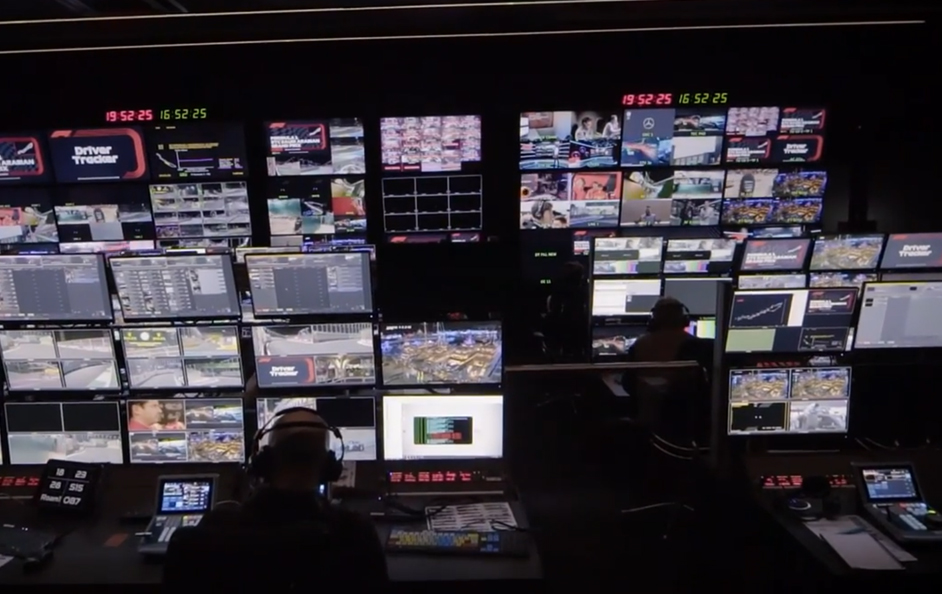
The leadership at Tata Communications recognises this and ensures that its engineering and non-engineering staff are adequately empowered. While this is a trait of the company across, it is even more emphasized within the F1 division.
“At any point anything could go wrong, it’s an unpredictable world and the complexities are enormous, but what we’ve done is to empower all teams so that they can respond in a matter of seconds, if not lesser. You don’t want anyone to wait on approvals,” says Mr Ponda.
This philosophy has reshaped the way global broadcast teams operate. Instead of centralised command structures, expertise is distributed across teams around the world, each capable of responding instantly to technical challenges.
The future
The partnership between Tata Communications and F1 continues to evolve. In 2022, the two organisations announced a multi-year strategic collaboration aimed at further expanding the sport’s digital capabilities.
As technologies such as cloud computing, edge networks, and immersive media continue to advance, the possibilities for sports broadcasting are expanding rapidly.
Says Mr Ponda, “We are working with F1 to bring next generation live media experiences to fans globally. This includes working on innovative ways to bring better quality content with richer data analytics, additional audio languages and fan-based commentary support to drastically improve the broadcast product.
“In 2012 there were ten teams; now for the first time F1 has 11. The sport is always evolving, pushing boundaries in technology and experience like no other sport does. The cars are smaller and smarter, there are new destinations, rookies come, veterans get better. But what is constant with F1 is the trusted partnership with Tata Communications,” sums up Mr Ponda.
Just as elite drivers constantly push their limits on the track, Tata Communications continues to push the limits of sports broadcasting. Invisibly.
- Haroon Bijli