June 2026 | 1682 words | 6-minute read


No brokers, no boundaries
mjunction’s Jorhat Tea e-Marketplace revolutionised Assam’s tea industry by eliminating costly intermediaries and warehousing, enabling direct, digital auctions. Launched in 2020, the ex-factory model allows sellers to retain control, reduces the production-to-payment cycle from 30 to 12 days, and cuts transport and sampling costs by 40% and 53%. In FY25, tea sellers saved Rs 3.5 crore and achieved 3-5% higher margins. The platform onboarded 557 buyers and sellers, captured 7% of Assam’s market, and tripled revenue. mjunction’s scalable, integrated ecosystem, formed by Tata Steel and SAIL, now operates across 150 categories, facilitating Rs 2 lakh crore in transactions annually.
No brokers, no boundaries
mjunction’s Jorhat Tea e-Marketplace has revolutionised Assam’s tea industry, challenging centuries-old broker-driven auction systems. Traditionally, producers had to transport tea to warehouses for auctions, incurring significant transport, warehousing, and sampling costs, while brokers often eroded prices and excluded small growers. mjunction, a joint venture between Tata Steel and the Steel Authority of India, launched the ex-factory model in 2024, enabling sellers to list tea virtually without moving it, with only samples sent to buyers. This broker-free, digitally integrated platform connects logistics, inventory, finance, quality assessment, analytics, marketing, warehousing, and payments, streamlining the entire transaction lifecycle. The model reduced the production-to-payment cycle from 30 to 12 days, cut transport costs by 40%, eliminated warehousing and brokerage fees, and halved sampling costs. In FY25, tea sellers saved Rs 3.5 crore, achieving 3-5% higher margins per kg. With Assam producing 65-70 crore kg annually, statewide adoption could save Rs 300-350 crore. The platform has onboarded 557 buyers and sellers, a 75% increase, and captured 7% of Assam’s tea market in one year, with revenues tripling from Rs 81 lakh to Rs 212 lakh. mjunction’s approach has opened formal auctions to small growers, removed entry barriers, and delivered fresher tea to buyers. Recognised with the Tata InnoVista Award, mjunction’s scalable model aims to disrupt other agricultural commodities. Operating across 150 categories and 25 industries, mjunction now facilitates Rs 2 lakh crore in transactions annually, serving 3 lakh buyers and sellers from 55 locations.
No brokers, no boundaries
In the traditional tea industry of Assam, where sales have long depended on brokers and physical auctions, mjunction’s Jorhat Tea e-Marketplace has introduced a transformative, technology-driven model that is reshaping the sector. mjunction, a joint venture between Tata Steel and the Steel Authority of India, was originally launched in 2001 to sell steel online. Over two decades, it expanded to over 150 categories and 25 industry segments, becoming India’s largest B2B e-commerce platform. In 2020, recognizing the inefficiencies plaguing India’s Rs 1,00,000 crore tea market—especially the ex-warehouse auction system—mjunction launched the Jorhat Tea e-Marketplace in partnership with the Tea Board of India.
Historically, the tea auction system forced producers to move their tea to warehouses before sales, incurring significant costs: Rs 200 crore in transport, Rs 45 crore in sampling, and Rs 22 crore in warehousing annually for Assam teas. Brokers dominated the process, often resulting in 75% of lots being sold below assessed value and average price erosion of 25%. High entry barriers further limited buyer participation, excluding smaller players and leading 53% of tea to be sold privately, sacrificing price discovery for speedier payments.
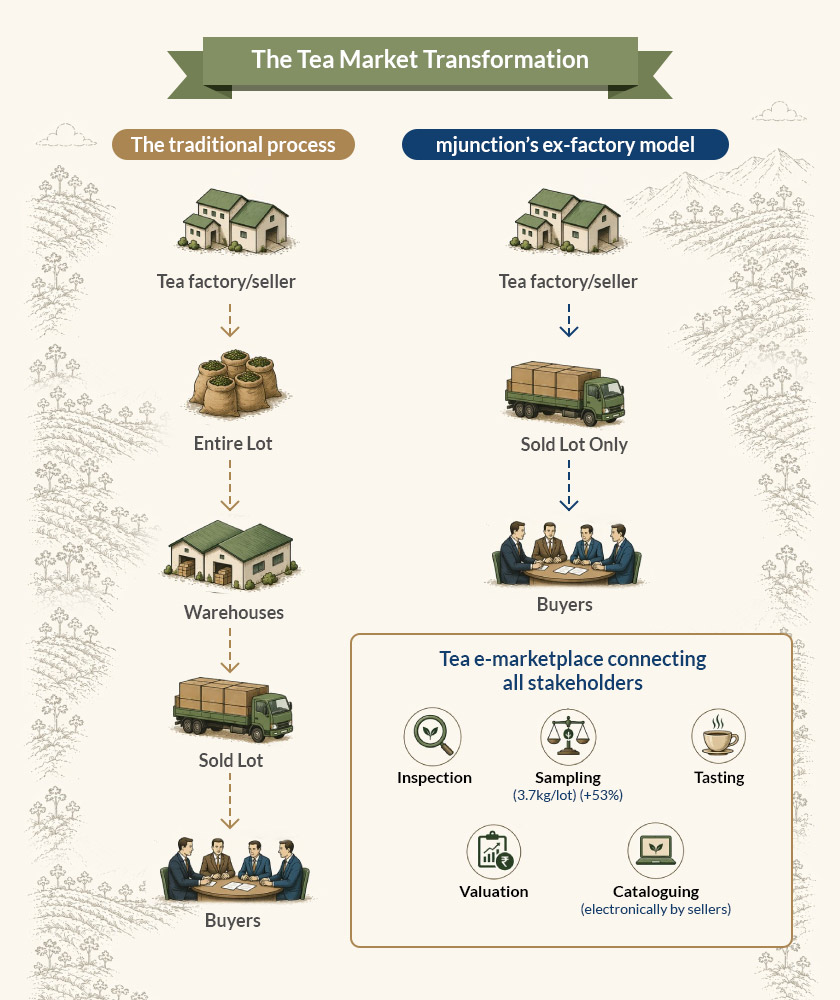
To address these challenges, mjunction introduced the ex-factory model in 2024, a first in India. Under this system, tea remains at the producer’s site until sold; only samples are moved to buyers, drastically reducing blanket sampling costs. Auctions are conducted online without brokers, allowing growers to set reserve prices and maintain control. The platform integrates logistics, inventory management, finance, quality assessment, analytics, marketing, warehousing, and payment gateways, creating a comprehensive digital ecosystem for all stakeholders.
The impact has been substantial. Since June 2024, the production-to-payment cycle has shortened from 30 to 12 days, ensuring buyers receive fresher tea. Transport costs dropped 40% (from Rs 3/kg to Rs 1.8/kg), warehouse and brokerage fees were eliminated, and sampling costs reduced by 53%. Tea sellers realized savings of Rs 3.5 crore and margin improvements of 3-5% per kg in FY25. If adopted statewide, annual savings could reach Rs 300-350 crore. The platform has democratized access, enabling small growers and entrepreneurs to participate in auctions without entry barriers, and buyers to procure tea centrally.
Market penetration has been rapid: in FY25, 80 lakh kg of tea were sold via the platform, growing to over 1 crore kg in FY26. Within a year, the platform captured 7% of Assam’s tea market, revenues nearly tripled from Rs 81 lakh (FY24) to Rs 212 lakh (FY25), and the number of buyers and sellers onboarded rose 75% to 557. mjunction’s efforts were recognized with the Tata InnoVista Award for innovation.
The ex-factory model’s success demonstrates that transparent, digital platforms can disrupt centuries-old practices, enhance value for all supply chain participants, and be scaled to other commodities like spices and pulses. mjunction’s journey from a steel e-marketplace to a multi-sector B2B powerhouse underscores the importance of solving industry problems through innovation, transparency, and stakeholder integration, ultimately shifting the balance of power in favor of producers and buyers.


In the rolling tea gardens of Assam, where the practice of selling tea through brokers has barely changed in two centuries, a quiet revolution is unfolding. It started with an elegant, if audacious idea: what if sellers didn’t have to move their tea to warehouses at all? And what if the entire tea ecosystem — warehouse, transporters, financiers, and tea tasters — is digitally connected without any intermediaries?
This idea did not emerge from a boardroom in China or the UK, but from mjunction services, a joint venture formed by two unlikely partners — Tata Steel and the Steel Authority of India. Launched in 2001 as a platform to sell steel online, the company has since expanded across more than 150 categories and 25 industry segments, and is, today, India’s largest B2B e-commerce company, spanning the entire B2B e-commerce spectrum. In 2020, the company launched Jorhat Tea e-Marketplace — a direct challenge to the structural inefficiencies of one of India’s oldest agricultural sectors.
The problem
According to India Brand Equity Foundation, India is the world’s second-largest tea producer, harvesting 120.3 crore kg in FY25, and ranking among the top five exporters globally. More than half of that output — 52% — comes from Assam alone. Industry reports estimate that India’s tea market, valued at ~Rs 1,00,000cr today, is projected to grow to Rs 1,50,000cr by 2033, underscoring its importance to the economy. Yet deep-seated inefficiencies persist, preventing this growth from being equitably shared across the supply chain.

At the heart of the problem is the traditional ex-warehouse tea auction system. It requires producers to move their tea to warehouses before bidding can begin at Tea Board-regulated centres, stretching the production-to-payment cycle to ~30 days. mjunction says this system is costly for sellers: roughly Rs 200cr in transport costs, Rs 45cr for sampling, and Rs 22cr for warehousing annually, for Assam teas. The auction process requires the sellers to route their teas through brokers for sale. It points out that brokers often influence the price, resulting in ~75% of lots being sold below their assessed value, leading to an average price erosion of ~25%. High entry barriers further limit buyer participation, weakening competition and excluding smaller players.
As a result, mjunction notes, ~53% of Indian tea is now sold through private sales, as sellers trade the price discovery benefits of auctions for faster, more predictable payments. However, private sales restrict the sellers’ accessibility to a limited number of buyers without any assurance of timely payment.
The ex-factory breakthrough
When mjunction launched Jorhat Tea e-Marketplace for upper Assam, in partnership with the Tea Board of India, it quickly ran into widespread producer frustration with the existing auction system. “The producers are all in very bad shape and many plantations are shutting down,” says Vinaya Varma, Managing Director and Chief Executive Officer, mjunction. “So, we started examining how tea growers could get fair prices by removing costs from the system, not by shifting value from buyers to sellers. The goal was to benefit the entire Indian tea industry. Warehousing emerged as one of the biggest costs in the system and eliminating it became our goal.”
What changed
For sellers
- 40% reduction in transport costs (down from Rs 3/kg to Rs 1.8/kg)
- 0 warehouse rental and brokerage fees
- 53% reduction in sampling cost
- 3-5% higher margins per kg
- Rs 3.5cr saved by tea sellers in FY25
For buyers
- 0 brokerage or intermediary fees
- No entry barriers to procurement
- Centralised lifting, replacing manual collection from multiple warehouses
- Fresher tea, enabled by a shorter production-to-payment cycle of just 12 days
For the tea business
- <1% to 7% market share growth (FY24 to FY25)
- 7% of Assam’s tea market captured in a year
- ~3X growth in revenue, from Rs 81L (FY24) to Rs 212L (FY25)
- 557 buyers and sellers onboarded a 75% year-on-year increase
In 2024, mjunction arrived at a counter-intuitive idea: what if the tea never moved at all? The result was the ex-factory model — a first-of-its kind approach in India. Under this model, sellers do not move their tea before the auction. Rather, after the lots are listed virtually, only samples move through mjunction’s logistics network, which ensures relevant samples reach relevant buyers, removing the cost and waste of blanket sampling.
“The lots are then auctioned online, where tea growers retain control — setting their own reserve prices — as our platform is broker-free by design,” says Mr Varma. “In fact, none of our platforms have brokers. Tea growers, who were unhappy about being forced to sell through brokers, are glad to be in the driver’s seat.”
Measurable gains
The impact of the ex-factory model has been striking. Since its implementation in June 2024, the production-to-payment cycle has reduced from 30 days to 12, thereby ensuring buyers receive noticeably fresher tea. Transport costs have fallen 40% — from Rs 3/kg to Rs 1.8/kg. Warehouse rental costs and brokerage fees have been eliminated entirely. Sampling costs have been cut by 53%. In FY25, tea sellers using the platform saved Rs 3.5cr and realised margin improvements of 3-5% per kg. Given that Assam produces 65-70 crore kg of tea annually, statewide adoption of the new model could unlock savings of Rs 300-350cr across the value chain.
Behind these savings lies a deeper redesign of how tea is traded. The platform has knitted together every critical participant into one digital ecosystem for the entire transaction life cycle. The marketplace integrates logistics, inventory management, financial support, quality assessment, analytics, marketing, warehousing, and payment gateways — meaning it does not simply clear prices, it processes the entire transaction. It is what Mr Varma describes as “an integrated e-marketplace rather than merely an e-auction.”
Buyers, freed from the entry barriers of guarantors and bulk purchase requirements, can participate from anywhere in the world, and lift tea from a centralised location. The platform has opened formal auctions to small tea growers and first-time entrepreneurs previously shut out of the system. “I’m happy that we have challenged practices that are centuries old,” says Mr Varma. In FY25, producers sold 80 lakh kg of tea through the platform, and more than 1 crore kg in FY26.
As of today, the platform has onboarded 557 buyers and sellers, representing a 75% increase in stakeholders from FY24 to FY25. Within one year of operations, it captured 7% of Assam’s tea market, while revenue has grown from Rs 81L in FY24 to Rs 212L in FY25 — an almost threefold increase.
Unlikely beginning
Founded in 2001 as a 50:50 joint venture between Tata Steel and the Steel Authority of India, mjunction is, by any measure, an unusual company. It started as metaljunction.com, a B2B e-platform for steel sales at a moment when the dotcom boom had already gone bust. Its survival and eventual success owe much to its founding discipline: “solve the problems in the industry, make commerce convenient, and let transparency through robust governance do the rest,” states Mr Varma.
What started as a way to streamline sales for two major steel producers has evolved into a neutral digital marketplace where buyers and sellers from across the supply chain can transact transparently, without the friction of intermediaries or the need for bilateral negotiations.
The company realised early on the opportunity to expand its offering to other industries and verticals. Over two decades, it expanded to serve multiple industries, from steel to coal, oil, gas, auto, tea, oilseeds, paddy, idle assets and beyond, while also adding horizontal services, including finance, procurement, loyalty, as well as cross-border trade through its recently launched rivexa platform. This also includes a B2B liquidation e-marketplace for the sale of unused, obsolete, and surplus maintenance, repair, and operations spares at an attractive price called mjvaluemart. “This prompted us to change the name of the company to mjunction, and metaljunction became a business unit,” says Mr Varma. “This expansion resulted in mjunction growing at a rate that was five times more than what it would have, had it remained only confined to a vertical in the ferrous space.”
The company operates on both sides of the supply chain — serving buyers and sellers simultaneously. Today, mjunction facilitates transactions worth more than Rs 2L cr annually, operating from more than 55 locations across India and abroad, and serves 3 lakh buyers and sellers.
Earning trust
Developing the solution and encouraging participation has not been straightforward. “It might sound simple, but the tea industry has been functioning the same way for over 200 years, so there will be resistance to change,” says Mr Varma. The trick, he says, is to identify those few stakeholders that will welcome, or be open to, the change. “We focused on supporting and working with these stakeholders to establish an early success,” he explains. “Once we were able to do that, then those sitting on the fence were willing to give it a try and came over to our side.” The company has demonstrated, transaction by transaction, that the ex-factory model delivers on its promises while also managing the risk that sellers, uncertain of the new system, might lose sales in the transition.

Shifting the balance
In October 2025, mjunction was recognised with the Tata InnoVista Award — the Group’s flagship innovation recognition — in the Business Support and Business Model Innovations category. The award validates its efforts to transform the tea supply chain through technology, transparency, and inclusion.
The platform’s architecture — ex-factory logistics, focused sampling, broker-free price discovery, integrated stakeholder ecosystem — is, according to mjunction, scalable to spices, pulses and other agricultural commodities. “We are working on a platform for spices and will crack it soon,” says Mr Varma. “We are partnering with banks, logistics providers, and transporters to solve financing and supply chain challenges and connect farmer-producer organisations directly with buyers, so as to eliminate any costs in the middle, including traders who take 20% of the value.”
In commodity markets historically dominated by information gaps and entrenched intermediaries, mjunction is betting that transparent, thoughtful deployment of technology can shift the balance of power. The early results from Assam’s tea gardens suggest that the bet is paying off.
— Kermin Bhot