February 2026 | 1,900 words | 7-minute read


Building India’s AI Creators at Scale
At the Tata Bharat YUVAi Hackathon, 1,800+ non-developer students from diverse fields built 1,500 working apps in 90 minutes using voice-first AI tools in nine Indian languages, without coding. Held at Bharat Mandapam during the India Impact Summit 2026, the event demonstrated AI’s power to democratize technology, enabling arts, science, and commerce students to solve real-world problems in healthcare, education, environment, and governance. Supported by TCS mentors, students leveraged their domain knowledge and empathy, producing grounded solutions. The hackathon, part of a nationwide movement, aims to reach 1 million students, fostering digital inclusion and expanding India’s technology revolution.
Building India’s AI Creators at Scale
At the Tata Bharat YUVAi Hackathon, held during the India Impact Summit 2026 at Bharat Mandapam, over 1,800 students—none with prior coding experience—built 1,500 working apps in just 90 minutes. This unprecedented event, led by Tata Consultancy Services (TCS), showcased true technology democratization. Students from diverse fields like Sanskrit, nursing, agriculture, and commerce used voice-first AI tools supporting nine Indian languages to identify real-world challenges and create digital prototypes without writing code. Guided by TCS mentors and using a purpose-built tool, IdeaFlow, students tackled challenges across three themes: People (healthcare, education, livelihoods), Planet (environment, sustainability, climate), and Progress (governance, infrastructure, innovation). Most students addressed People-centric problems, with healthcare and education as top priorities, reflecting empathy for underserved groups like students, elderly, and farmers. Applications ranged from rural healthcare solutions to food distribution platforms and support for first-generation college students. The hackathon highlighted that India’s digital future isn’t limited to STEM graduates; AI enables non-tech students to leverage their domain knowledge and lived experience, producing grounded, impactful solutions. TCS emphasized that AI removes barriers of language and technical expertise, empowering all young Indians to innovate. The event was the culmination of a nationwide movement, with satellite hackathons at 22 colleges reaching over 10,000 students, and high completion rates signaling strong demand. TCS plans to scale the program to 1 million students, aiming to foster digital inclusion and unlock India’s next generation of AI-enabled entrepreneurs by 2026.
Building India’s AI Creators at Scale
The Tata Bharat YUVAi Hackathon, held at Bharat Mandapam during the India Impact Summit 2026, marked a transformative moment in technology democratization. Over 1,800 students with no prior coding experience, from diverse fields such as Sanskrit, nursing, agriculture, commerce, and more, gathered to build functional software applications in just 90 minutes. Utilizing TCS’s voice-first AI tool, IdeaFlow, which supports nine Indian languages, these students identified real-world problems, developed solutions, and created working digital prototypes—without writing a single line of code or needing English proficiency. This event was not a mere demonstration but a proof of a civilizational shift, showing how AI can empower anyone, regardless of background, to become a digital creator.
Each student was challenged to address an issue under three themes: People (healthcare, education, livelihoods), Planet (environment, sustainability, climate), and Progress (governance, infrastructure, innovation)—the pillars of the India-AI Impact Summit 2026. Every group of five students was guided by a TCS mentor through a structured process, resulting in 1,500 working apps, with 1,217 completing the full journey and 199 reaching prototype stage. The majority (58.4%) chose People-related challenges, particularly healthcare and education, reflecting empathy for India’s underserved populations, such as students, the elderly, and farmers.
The hackathon produced impactful solutions: apps for rural preventive healthcare, tools for elderly safety, platforms connecting first-generation students to scholarships, solutions for reducing air pollution, and support for farmers and skilled women. For instance, Vritika Singh, an MBA student, created an app to redistribute leftover food from events to those in need, inspired by her own experiences with food wastage.
TCS leaders emphasized that the real innovation lay in leveraging students’ domain knowledge and community insights, not technical skills. CEO K Krithivasan encouraged students to focus on meaningful problems from their own lives and communities. Ashok Krish, VP and Head of AI Practice, highlighted that as AI lowers the barriers to technology creation, the ability to deeply understand and frame real-world problems becomes paramount. Students from non-technical backgrounds, long excluded from India’s technology revolution, demonstrated that their lived experiences and empathy, combined with AI, could deliver sophisticated, human-centered solutions.
Mentors, such as Srilekh S and Felina Christy, found the experience rewarding and transformative, witnessing firsthand how non-technical students could innovate with AI. Felina, herself from a mathematics background, noted the excitement and potential for non-tech graduates to start AI-driven careers.
The hackathon was the culmination of a broader movement, with satellite events at 22 colleges across 10 states, engaging over 10,000 students and consistently achieving high completion rates. The overwhelming demand and success prompted a commitment from TCS to scale the program to reach 1 million students, aiming to build a national movement for digital inclusion and empower the next generation of digital entrepreneurs, regardless of stream, background, or language. This initiative showcases India’s vast demographic dividend, extending technology’s promise to all young people with domain knowledge and empathy, turning AI into a true force for national progress.


- 0.5×
- 0.75×
- 1×
- 1.25×
- 1.5×


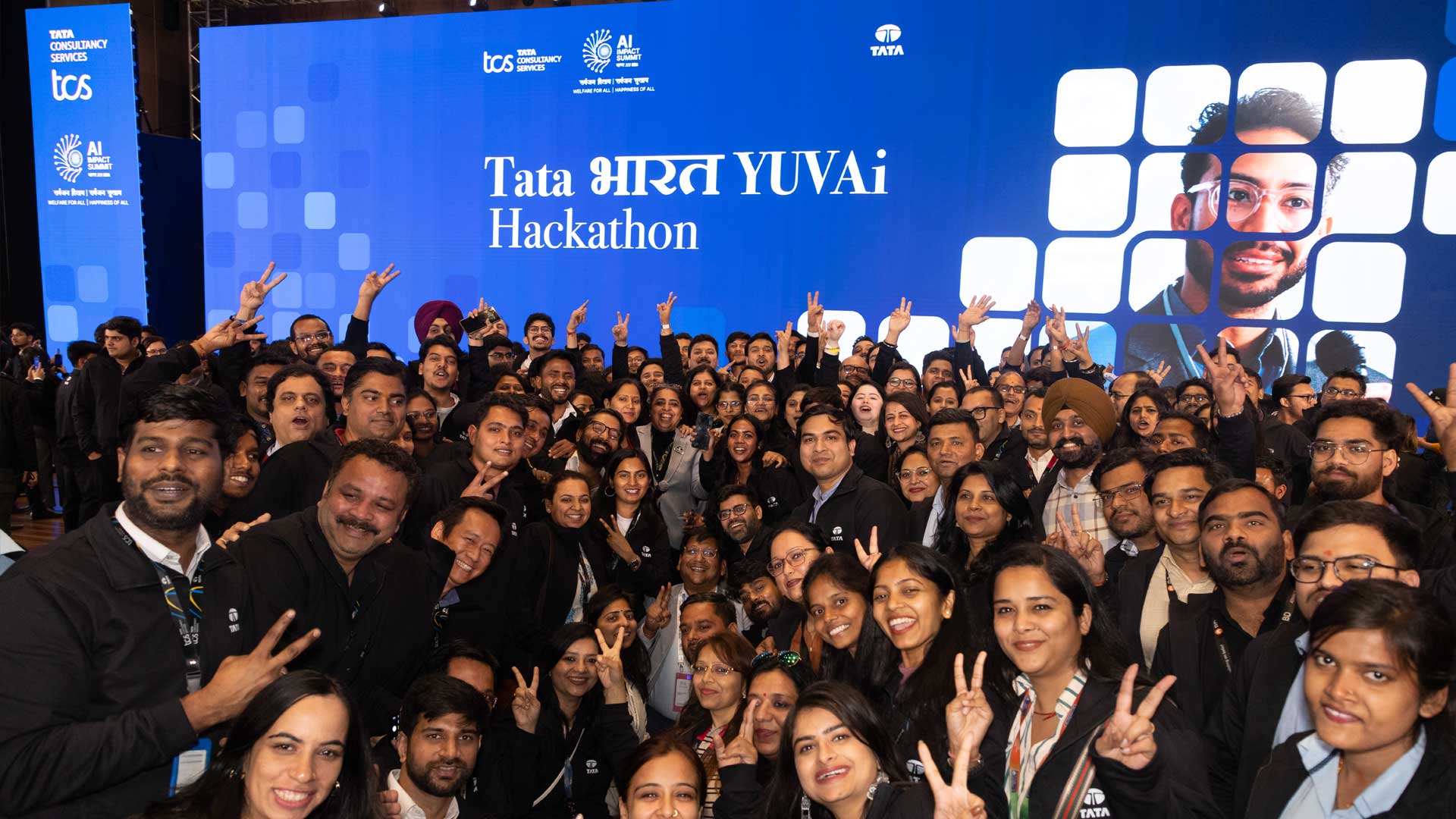
1800+ students who’d never written a line of code. 90 minutes. 1,500 working apps! The Tata Bharat YUVAi Hackathon — the world’s largest AI hackathon for non-developers — at the India Impact Summit 2026 showed the world what happens when technology is truly democratised.
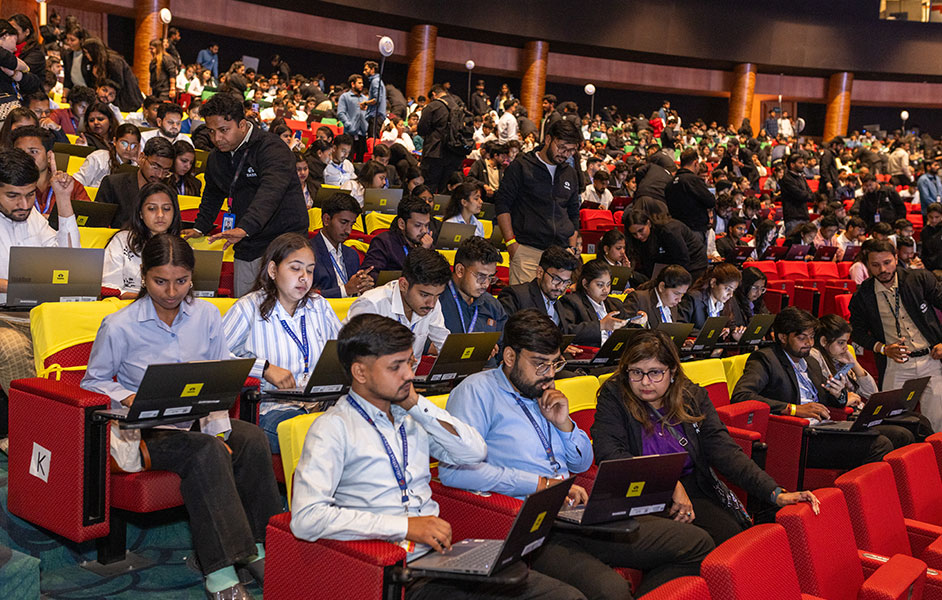
What happened at Bharat Mandapam on February 17, 2026, had never happened before anywhere in the world, said Tata Consultancy Services (TCS), the driving force behind this initiative: “Students studying subjects like Sanskrit, zoology, nursing, agriculture, criminology, pharmacy, and commerce walked into a hall, sat down in front of laptops, and built working software applications. Not one of them had ever written a line of code. They didn’t learn to code today either. They didn’t need to.”
The company added, “Using voice-first AI tools that work in nine Indian languages, these students went from identifying a real-world problem to holding a working digital prototype in their hands — in roughly 90 minutes. They spoke in Tamil, Hindi, Telugu, Malayalam and Sanskrit! The AI listened, and helped them build… This was not a technology demo. This was proof of a civilisational shift.”
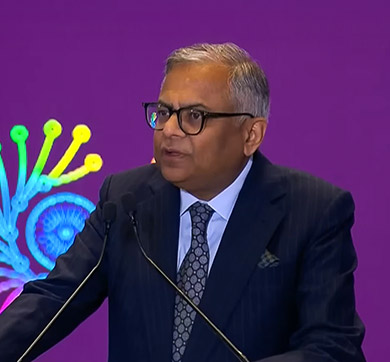
AI fundamentally does something very, very special. It is going to kill the barriers of high value activities, so every person can operate at a higher level… It's the biggest equaliser. What makes a person successful?... It is confidence. If we can give confidence to every citizen, and if we can put an AI tool in the hand of every citizen, life changes. So, it's going to be very, very profound. -- N Chandrasekaran, Chairman, Tata Sons
Those 90 minutes…
Each student was given a challenge connected to a real problem under three themes: People (healthcare, education, livelihoods), Planet (environment, sustainability, climate), and Progress (governance, infrastructure, innovation). The three principles that anchored the India-AI Impact Summit 2026.
Every 5 students was supported by one mentor from TCS. “Using a purpose-built AI tool called IdeaFlow,” TCS explained, “students walked through a structured process: pick a challenge, identify the people you’re helping, dig into why the problem exists, generate ideas, create a build plan, and then — the part that surprises everyone — actually build a working app. No drag-and-drop templates. No toy outputs. Real, functional, interactive applications.”
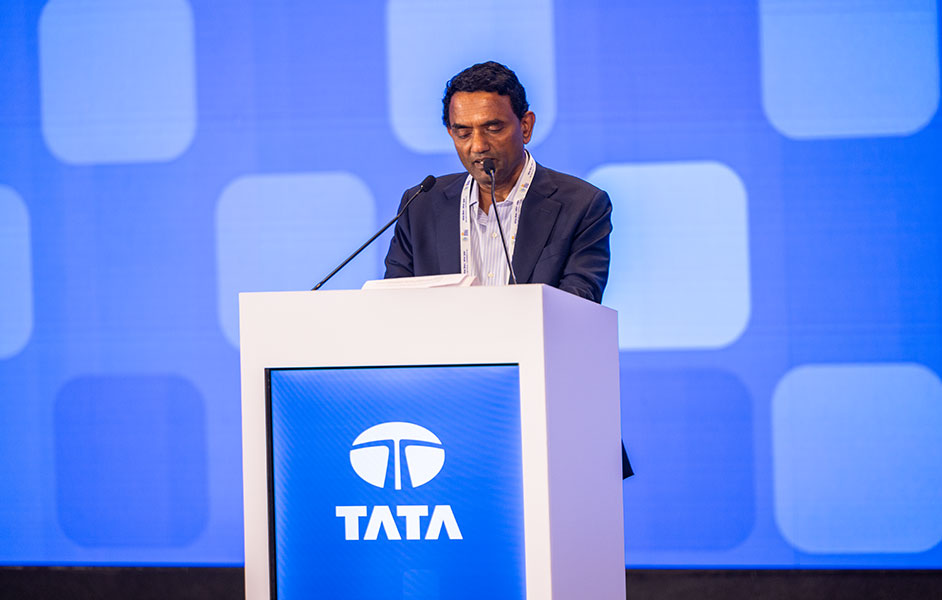
Addressing the students in his opening remarks, K Krithivasan, CEO & MD, TCS, said, “Your knowledge is your strength. You don’t have to know technology or coding. You don’t have to know English. Your knowledge of the subject you are studying, your knowledge of the needs and opportunities of the community you live in is your strength. You can create solutions that improves the lives of all of us and for each one of you. So, my request to all of you is focus on the problems that matter to you — your community, your campus and your future… and keep working towards a better solution, a better tomorrow.”
58.4% of the students chose ‘People’ challenges (healthcare, education, livelihoods), making it the runaway favorite theme, followed by ‘Planet’ (22.9%) and ‘Progress’ (18.7%). Of these, healthcare was the #1 challenge picked, followed by education. Students, elderly people, and farmers were the most frequently identified beneficiaries across all prototypes, reflecting deep empathy for India’s most underserved populations.
Of the 1,500 working apps built, 1,217 completed the full journey, and 199 reached prototype stage in the single session. This included apps for preventive healthcare in rural areas, apps to help elderly people living alone stay safe, tools to connect first-generation college students with scholarships, platforms to reduce air pollution from everyday choices, and solutions to help farmers manage crops and skilled women find flexible work.
Vritika Singh, a designer and a first year MBA student, from Greater Noida, said, “We always thought that hackathons were for engineering students and developers. Today, we got to know that this is for management students, too.”
Ms Singh, who is a native of Jaunpur in Uttar Pradesh, dug into her own background to identify and solve a problem. She was motivated by the food wastage she witnessed around her at social events. “We end up throwing it out because culturally people around us get offended if we distribute the leftovers among them, and very few take the effort to go find those who could really use the food. We effortlessly dump all of it in the trash.”
She built an app to connect people to event organisers to have the food distributed among those who need it. “Without writing a single line of code and making an app in just 40 minutes was a great experience,” she said.
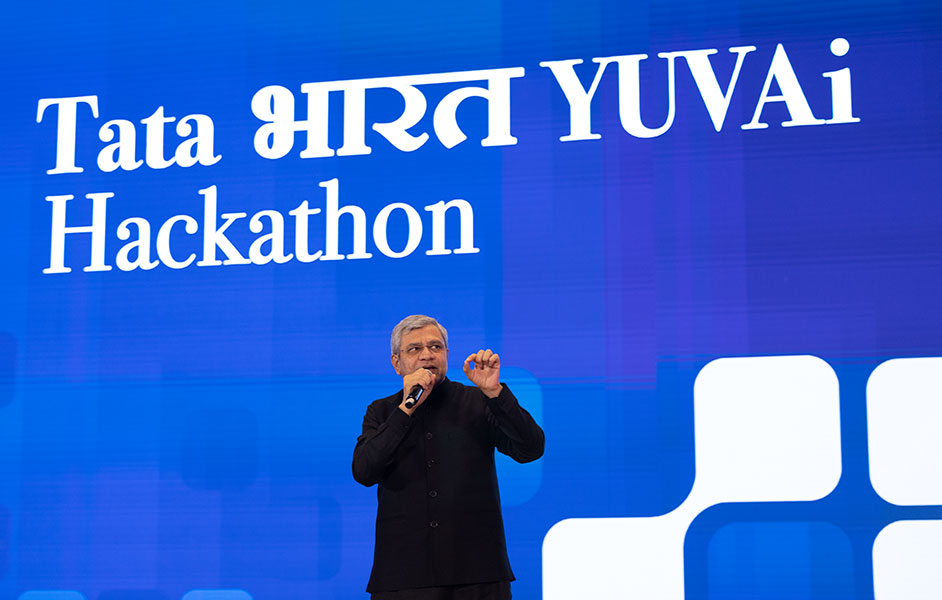
As the dashboard on the screen began throwing up ideas and statistics in real time, Ashok Krish, VP & Head of AI Practice, TCS, said from the stage, “I am always blown away when we see the actual apps people end up making. They have to realise that it is all of their knowledge of the problem [that made this happen]. The AI just acted behind the scenes to bring it out of you. You are in charge.”
I have come here today to feel the energy that you all have brought with you. The way you all are using technology to create new solutions, that’s phenomenal. What this proves is that AI can be used by everyone for solving your day-to-day problems, for creating solutions that you need, and you understand. - Ashwini Vaishnaw, hon'ble Minister of Railways, Information and Broadcasting, and Electronics and Information Technology
India’s Biggest New Opportunity
The implications of the numbers that appeared on the hackathon dashboard at Bharat Mandapam are staggering, especially when placed in the context of another set of numbers.
62.3% of India’s undergraduate students study arts, science, and commerce; but they are missing from the story of India’s technology revolution.
Every hackathon, every coding bootcamp, every digital skills programme is designed for the 11.8% who study engineering.
Or that only 10–12% of India’s population is fluent in English — the language that software has always demanded.
AI has demolished both barriers at once. Explains Mr Krish, “A hackathon by definition, has always been by techies, for techies, for people with a computer science and engineering background or people who have deep knowledge of programming languages.
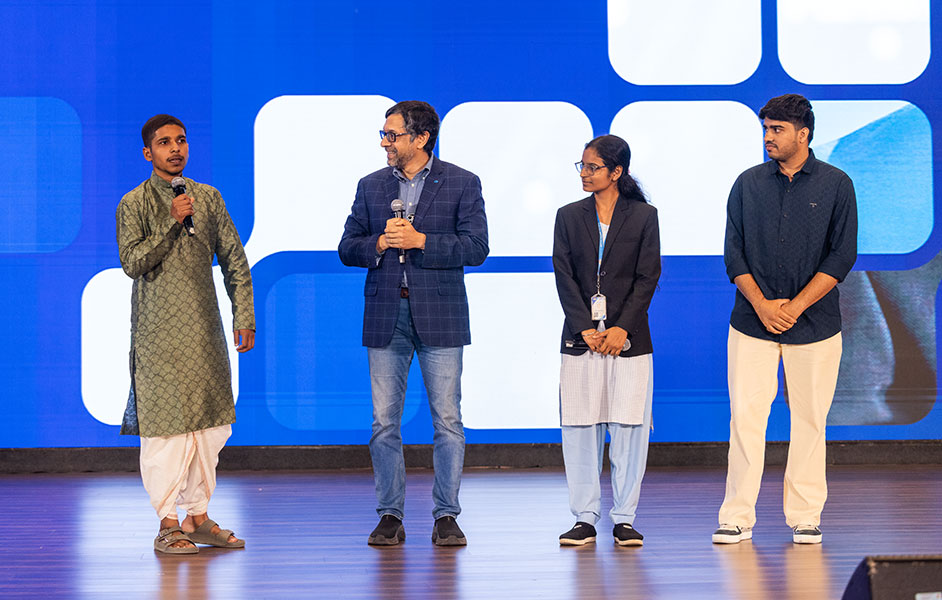
“What we are realising is that as AI democratises coding, the importance switches equally to people who can frame the right problem, who can think about a problem more deeply — think about who it impacts, about how to prioritise what to solve, about how change management might be complicated, about the people, the planet, the progress. We find that people from multiple disciplines, especially business or commerce or humanities or arts, bring a wealth of knowledge about the real world that they are now able to translate into building applications.”
For India, which has the world’s largest youth population and produces 30 million+ graduates every year, this demonstrates that the nation’s demographic dividend is not limited to STEM graduates. It extends to every young person with domain knowledge, empathy for real problems, and access to the right tools.
“These students bring something most engineers don’t have: deep, lived understanding of the problems they were solving,” TCS said. “A nursing student knows what patients actually go through. An agriculture student knows what breaks a farmer’s back. A commerce student understands why small businesses collapse. That empathy, combined with AI that could turn their thinking into software, produced solutions that felt grounded, human, and surprisingly sophisticated.”
“When a zoology student in Coimbatore can build a wildlife monitoring app, or a BA Tamil student in Chennai can create a heritage language learning platform, or a BBA student in Lucknow can prototype a tool that helps small businesses access government schemes — that is not just innovation. That is a fundamental expansion of who gets to participate in India’s digital future” the company added.
Mr Krish added, “For India, this is the opportunity of a lifetime to upskill the wider population on what it means to use AI and to become anything that you want — no language barriers, no technology barriers, no urban vs rural barriers. AI can plug any gap that you have. So, you plus AI become a force for India’s future given the demographic dividend of young people we have.”
Mentor Speak
The mentor network that will drive this initiative forward is made of TCS employees with varying backgrounds and experience.
Srilekh S, who has been with TCS for 20 years, is a gold certified mentor. At the hackathon, she was mapped to a group of 5 students of English literature and psychology. “When they get into an organisation, they are bound by so many things. They get a different personality all together; they understand and start thinking in a different way,” she said. “But when you are a student, you are like a free bird. Your thought process is so diffferent. Students are not bound… It’s a learning experience for mentors, too.”
In the same room was Felina Christy, who has worked with TCS for only about a year and has a background rooted in pure math.
“I was from a non-technical background — a MSc mathematics student,” she said. “I was able to build AI. I am building agents. So, why won’t other people be able to do that? Majority of Indian graduates are non-tech. Why can’t they start their career in AI? That’s what inspired me.”
A Zone Mentor with 60 to 70 students, spanning economics, criminology, forestry, pharma, she added, “It’s fascinating. They know their domain; they know what they are facing. The person who knows what is happening can get a better solution. Seeing people get excited about what AI can do is making me excited. When they know the actual power of AI, they can do so many things. I am very happy that I am able to mentor them and shed light on what the future is.”
A Movement in Motion
The Tata Bharat YUVAi Hackathon at Bharat Mandapam was the crescendo of a wave that was building across the country. In the six weeks leading up to it. The team ran satellite events at 22 colleges across 10 states — spanning South, North, East, and West India — reaching 10,000+ students.
At several colleges, demand exceeded capacity. Gurunanak College in Chennai saw nearly double its expected turnout. Royal Global University in Guwahati overshot by 30 percent. Completion rates across these events consistently held between 88 and 93 percent. “The hunger,” TCS said, “is real.”
Mr Krithivasan committed, “This is not the end. We intend to scale this programme to reach 1 million students over the next few months, building a national movement that helps learners turn ideas into practical solutions. This reflects the Tata Group’s commitment to Digital Inclusion, ensuring opportunities not limited by backgrounds, stream or language.”
The satellite model has proven that the programme is scalable and repeatable. The tools are built. The mentor network is trained. The demand is unmistakable. And the Tata Group’s ambition is to unlock the next million digital entrepreneurs for the AI era by the end of 2026.
- Monali Sarkar [with inputs from Anju Maskeri]