February 2026 | 2511 words | 10-minute read


Tata AI Sakhi Immersion Program
The Tata AI Sakhi Immersion Programme, held at the India AI Impact Summit 2026 in Delhi, brought together 1,553 rural women from nine states, many experiencing the capital or air travel for the first time. Over 2.5 hours, participants completed 4,727 hands-on AI tasks using their own smartphones in Hindi, breaking barriers of literacy and technical expertise. Supported by Tata Group’s community initiatives, women from diverse professions learned to use AI for business, creativity, and accessing government schemes. The event’s focus was practical empowerment and knowledge transfer, with completion rates of 97-98%, marking a milestone in rural digital inclusion.
Tata AI Sakhi Immersion Program
The Tata AI Sakhi Immersion Program, held at the India AI Impact Summit 2026 in Delhi, marked the world’s largest single-session AI skills immersion for rural women. Bringing together 1,553 women from nine states—including Jharkhand, Bihar, West Bengal, Odisha, Punjab, Rajasthan, Maharashtra, Gujarat, and Delhi NCR—the event aimed to demonstrate AI’s practical potential for economic upliftment and opportunity. These women, beneficiaries of Tata Group’s community development initiatives, had little to no prior AI experience. In just 2.5 hours, with only their smartphones, they completed 4,727 hands-on AI tasks—ranging from drafting business communications and navigating government schemes to generating product designs and marketing materials.
Organized into Artisanal, Digitally Literate (Basic), and Advanced cohorts, participants received personalized mentorship from 400 trained guides. The session emphasized AI’s accessibility—delivered entirely in Hindi, using voice input to overcome literacy barriers—and highlighted responsible usage, warning against sharing sensitive personal information. Stories from participants like Pushpa Kumari and Mittal Karsanbai Rabari illustrated AI’s transformative impact on rural entrepreneurship, education, and self-confidence. Artisans used AI to visualize designs and streamline production, while digital entrepreneurs leveraged it for business growth and community training.
The program’s real test lies ahead, as these women return home to apply their new skills, aiming for increased income and independence. The Tata Group’s initiative, built on years of digital CSR work, demonstrates how AI can empower even the most marginalized, provided it is accessible, relevant, and community-driven. Completion rates exceeded 97%, underscoring the women’s enthusiasm and the program’s effectiveness in democratizing AI.
Tata AI Sakhi Immersion Program
The Tata AI Sakhi Immersion Program, held at Delhi’s Bharat Mandapam during the India AI Impact Summit 2026, marked a milestone as the world’s largest single-session AI skills immersion for rural women. Bringing together 1,553 women from nine Indian states—including Jharkhand, Bihar, West Bengal, Odisha, Punjab, Rajasthan, Maharashtra, Gujarat, and Delhi NCR—the event aimed to break barriers and demonstrate how artificial intelligence can be a tool for economic empowerment, creativity, and opportunity.
Most participants, beneficiaries of community development and livelihood programmes run by Tata Consultancy Services (TCS), Tata Steel, Tata Power, and Tata Chemicals, arrived with little to no prior exposure to AI. For many, the event was their first visit to the national capital, and for some, their first time on an airplane. Despite their diverse backgrounds—ranging from millet entrepreneurs, seamstresses, and weavers to digital service providers and health workers—they shared a curiosity and eagerness to learn about AI.
The programme’s mission was clear: to put AI tools in the hands of every individual, especially those at the grassroots. Tata Sons Chairman N Chandrasekaran and TCS COO Aarthi Subramanian emphasized the importance of making technology accessible to all communities. Chief guest Smriti Irani, Chairperson for Gender Equity and Equality at CII, highlighted how unimaginable it once seemed for rural women—embroiderers, papad makers, self-help group members—to find a place in AI conversations.
The event’s format capitalized on the accessibility of smartphones and voice input, ensuring that literacy was not a barrier. With 400 trained mentors, participants were divided into Artisanal, Digitally Literate (Basic), and Digitally Literate (Advanced) cohorts. Over 2.5 hours, women completed 4,727 hands-on AI tasks—such as drafting business communications, generating product photos, navigating government schemes, and exploring new product designs. Completion rates were impressive: 97% for basic digital entrepreneurs and 98% for the advanced cohort.
The real-world impact was immediate. For Kumari Pradhan, a grassroots facilitator from Jharkhand, AI enabled her to quickly translate and explain government documents in simple Hindi, empowering her to guide others independently. Deepika Sachin Bhansode, a schoolteacher from Maharashtra, used AI to enhance her teaching, describing it as an “intelligent trainer.” Artisans found AI invaluable for visualizing product ideas, reducing the need for physical samples, and streamlining marketing efforts.
The program’s scale was the result of extensive preparation, including pilot runs and mobilization through Tata’s CSR networks. Selection prioritized women who could act as knowledge conduits within their communities. The session’s inclusivity—delivered entirely in Hindi, using Android smartphones—ensured broad participation.
Beyond technical skills, the event fostered confidence, networking, and a sense of possibility. Participants left determined to apply their new knowledge to their businesses and share it with others. As Ashok Krish, TCS Global Head of AI, noted, the initiative was not just a workshop but a catalyst for measurable, meaningful change—empowering rural women to use AI for income generation and independence, while emphasizing responsible use and data privacy.


- 0.5×
- 0.75×
- 1×
- 1.25×
- 1.5×


It was a late winter morning in Delhi. The city was just beginning to stir, but at the entrance of Bharat Mandapam — the venue of the India AI Impact Summit 2026 — the day had already begun. Rows of women draped in earthy hues and sunlit yellows were queued up to enter the venue. The excitement around what lies on the other side had been building up for weeks.
What awaited them inside the 3,000-seater Plenary Hall was the Tata AI Sakhi Immersion Program, the largest single-session AI skills immersion ever conducted for rural women and designed to demonstrate how AI can become a practical tool for economic upliftment, creativity, and access to opportunities.
Hailing from remote pockets of Jharkhand, Bihar, Odisha, Punjab, Rajasthan, Maharashtra, Gujarat, and Delhi NCR, they had come in buses, trains and flights — many setting foot on an airplane for the first time, and others stepping into the national capital for the first time. They were beneficiaries of the existing community development and livelihood programmes of Tata Consultancy Services (TCS), Tata Steel, Tata Power, and Tata Chemicals — initiatives that have equipped them with foundational training.
As diverse as their backgrounds were, there was a common thread binding them all: the curiosity and eagerness to understand, and engage with, what is arguably the biggest disruptor of our time: AI.
AI for All
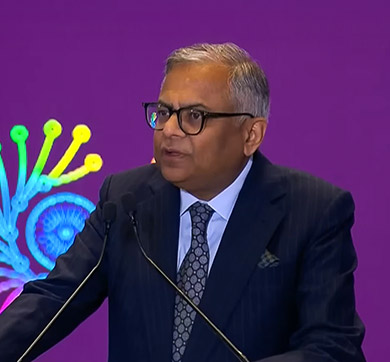
“Our mission should be to make AI work for every individual and every citizen in this country. We should put the AI tools in the hands of the last person in the country and, in fact, on the earth. That's the vision that we should all work towards,” Tata Sons Chairman N Chandrasekaran said in his India AI Impact Summit keynote at the Bharat Mandapam.
The Tata AI Sakhi Immersion Program was a step in that direction.
Gateway to AI
“While we discuss AI and its many opportunities at the Summit, we at TCS firmly believe that advancements in technology should benefit all communities,” said Aarthi Subramanian, Executive Director & Chief Operating Officer, TCS, opening the event.
These are people with no computing experience of any kind, no basic digital exposure, and yet look at what they were able to create in just three to four hours. It took us the last month to bring all these participants together and bring them to Delhi, but the sense of empowerment this has created is incredible. - N Chandrasekaran, Chairman, Tata Sons
Gracing the Tata AI Sakhi Immersion Programme as chief guest was Smriti Irani, Chairperson, Alliance for Global Good, Gender Equity & Equality, CII. Mrs Irani, who interacted with several participants from across states, struck a chord when she said nobody had imagined that a woman from a self-help group (SHG), a weaver, an embroiderer, or someone making papad at home could ever find a place in an AI conversation when the buzz around the technology first began.
It rang true for the women themselves. When called on stage, Pushpa Kumari, a TCS beneficiary from Dhanbad, Jharkhand, said travelling to a big city and speaking before a large audience in an auditorium felt almost surreal. “I’m grateful but also a tad nervous,” she admitted. “I come from a small village, where I run a shop called Pushpa Digital Seva Kendra. My parents are very proud that I’m here today. Whatever I learn at the session is something I hope to apply in my business and make it grow.”
Having come a long way both literally and figuratively, Ms Kumari urged the other women to believe in themselves. “I was a bundle of nerves at first, but as I speak, I feel better, more confident, and you will too,” she told the audience.
The women in the room represented an astounding range of professions: millet entrepreneurs, seamstresses stitching paramilitary uniforms, weaver of traditional crafts, digital services providers, crochet experts, maternal‑and‑child‑health workers and tribal‑language experts, among others. While some had braved personal odds, others had battled societal resistance to get to where they were.
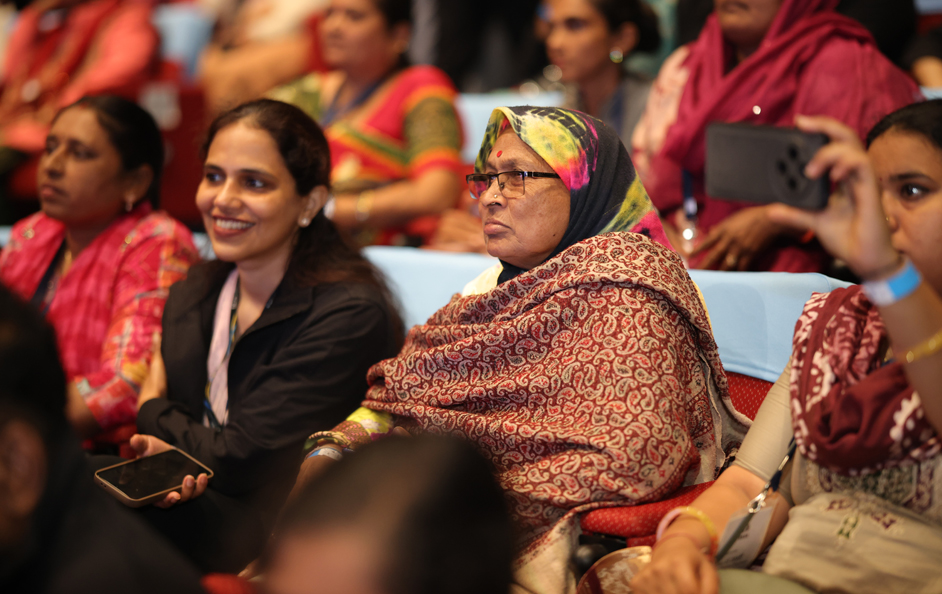
Mittal Karsanbai Rabari, an artisan from Dwarka, Gujarat, recalled the pushback she received from the community when she started working at Okhai, the rural women’s collective supported by Tata Chemicals in Mithapur. “People in my community used to say, ‘Girls shouldn’t go out; they should only cook at home.’ But thanks to my parents’ support, I was able to step outside and work.” At Okhai, she now handles marketing and sales, customer interaction and stall management at various programmes. “I have two children. I want to give them a good life. My elder son is, in fact, studying in a boarding school.”
Power in the palm of your hand
Traditionally, AI functions needed far more computing power than a phone could handle. But all that changed when advances in devices made it possible to run powerful models on an ordinary phone — which is why the women at the event had no devices barring a smartphone.
In many ways, AI has lowered the barrier, says Ashok Krish, Global Head, AI, TCS: “It allows women to work in their own languages, on a phone, without technical jargon or specialised expertise, making the technology feel less intimidating and more like a conversation with a trusted helper. And that is the real opportunity.”
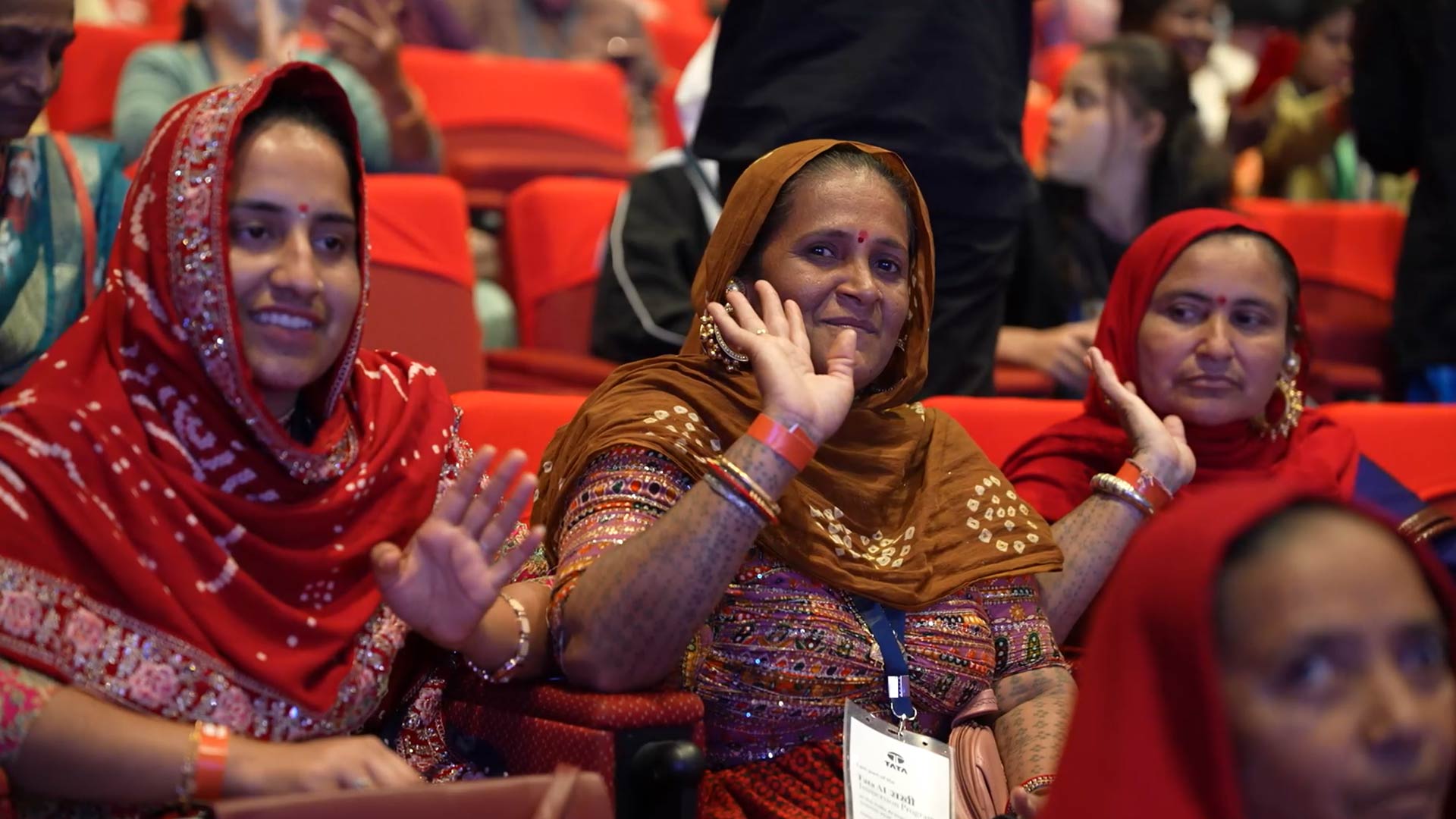
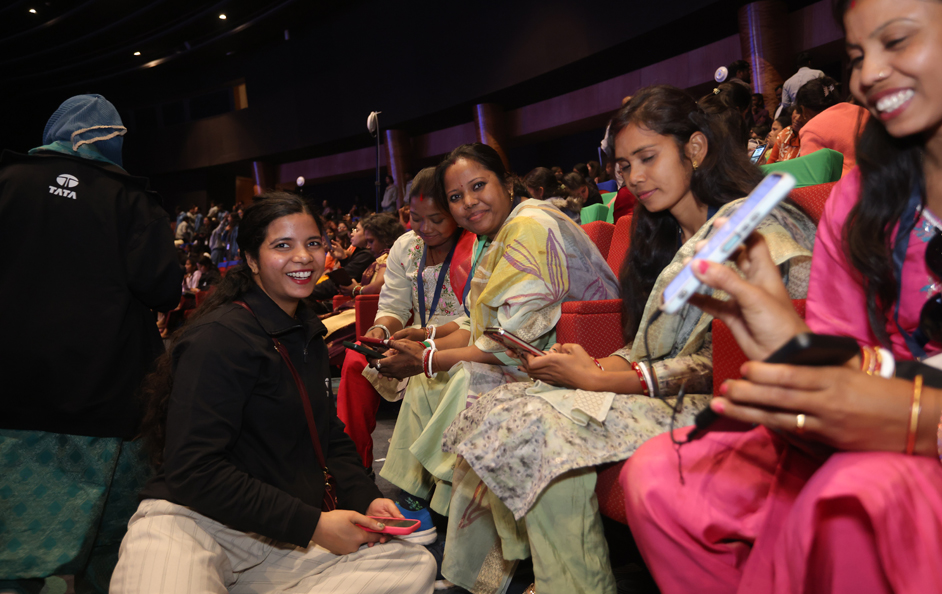
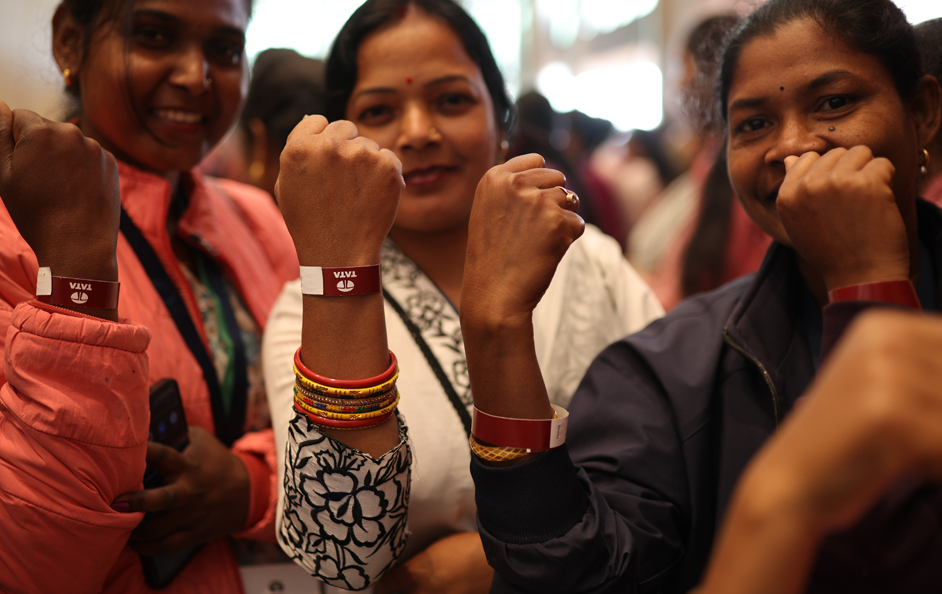
As the event got underway, with women using their own phones in their own languages under the guidance of Tata mentors, their comfort with smartphones was unmistakable as they scanned QR codes, tinkered with digital tools, and, of course, took selfies.
Organised into Artisanal, Digitally Literate (Basic), and Digitally Literate (Advanced) cohorts, with one mentor supporting five participants — there were ~400 trained mentors in the room — the women received personalised guidance and real-time problem-solving throughout the immersion. They explored new product designs, created marketing materials, navigated government schemes, translated documents, and draft applications.
A large screen displayed the real-time progress of all three cohorts and the states in action. It also showcased key milestones. For instance, a participant drafting her first formal letter with AI as her writing partner, or another creating a professional product photograph using AI.
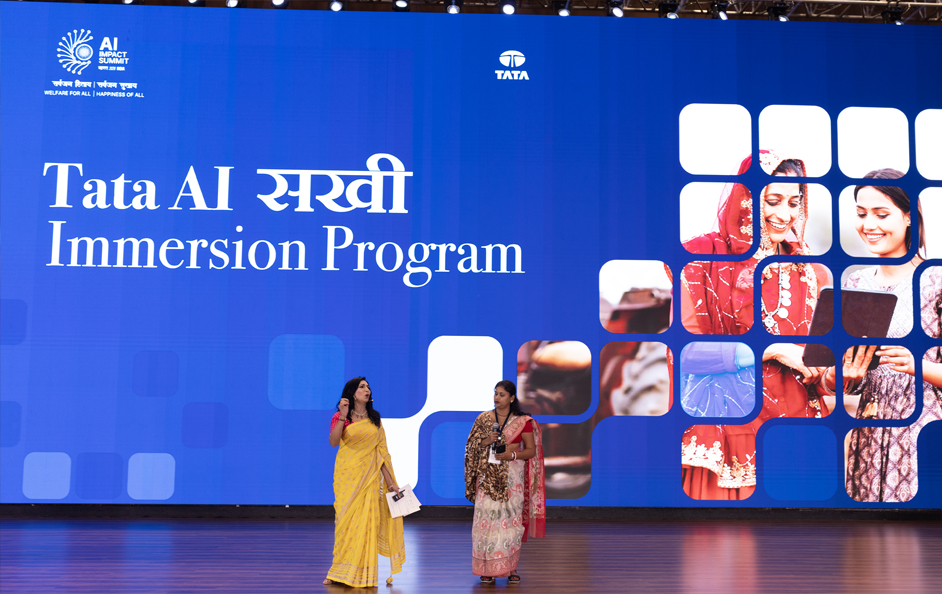
Productivity and speed aside, the session also highlighted the risks attached with having AI as a companion: that it can make mistakes and that it should be used responsibly, which includes not revealing any personally identifiable information like Aadhaar number on it.
New assistant on ground
The impact played out in real time, too.
For Kumari Pradhan from Jharkhand, her role as a grassroots facilitator with Tata Steel Foundation’s (TSF) DISHA — which empowers women from marginalised communities to become active leaders and changemakers in their local areas — involves conducting digital training in villages, guiding people through online services and IDs like the Ayushman Card and ABHA ID, along with other basic digital tasks that help them access government schemes and services more easily. “Earlier, if I didn’t fully understand a form or a rule, especially when it was in English, I had to call someone or wait to ask a senior. Now, with AI, I can just take a photo of the document and ask the app to explain it in simple Hindi. It saves time, and I can guide the women on the spot,” she said.
It is this newfound ability to find answers independently that Ms Pradhan found most empowering. The 29-year-old was at the venue with 10 others from the community, all of whom had travelled to Delhi for the first time. “My husband is taking care of my two kids, so I could travel without worry,” she said.
Ms Pradhan was one of many frontline facilitators who were beginning to lean on AI for clarity in their field and was part of the Digitally Literate (Basic) Cohort.
Deepika Sachin Bhansode, a schoolteacher from Satara, Maharashtra, and a beneficiary with Tata Power’s Anokha Dhaaga, was there to see what more AI could do for her. She had been applying AI in her work for almost two years, using it to strengthen learning outcomes for children who needed an extra push, placing her in the Digitally Literate (Advanced) Cohort. Describing it as an “intelligent trainer”, she said AI helped her overcome stumbling blocks when simplifying a complex concept or chapter: “AI helps me understand it clearly so I can teach the children better.”
Her school also uses an interactive blackboard with AI apps. Her comfort with the technology piqued her interest in exploring its potential. “I just want to absorb as much knowledge as I can and see what it can do for us as teachers,” she said.
Ms Bhansode beamed as she spoke, still revelling in her maiden flight. “It felt like we were floating,” she said with the broadest of smiles.
Among the Artists
For Apoorva Singh, a TCS engineer and mentor for the Artisanal Cohort, all it took was a couple of minutes to build a rapport with the women. “They were so enthusiastic and eager to learn. In fact, I found myself learning from them, too,” she said.
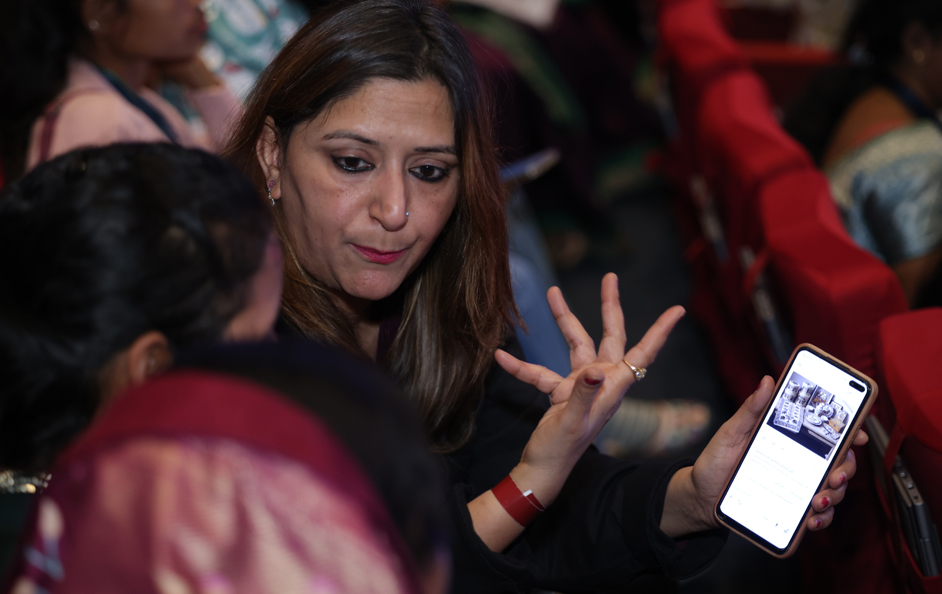
The focus among the artisans she mentored was practical: using AI to explore product ideas, visualise how items would look, and sharpen go-to-market plans. One artisan’s hand-painted cups became a case in point: with a labour cost of ₹20 and nearly 20 hours spent painting each piece, AI helped her assess whether she was underpricing for Tier2 and Tier3 markets.
Other artisans, like a group from the Okhai initiative, who were trained in embroidery, not in garment design used AI to help bridge that gap. They were also able to use AI to eliminate the need to create many physical samples, like they traditionally did; now, they could digitally visualise and produce just the selected sample. This not only improved their output but also reduced waste. Another bottleneck they encountered were photo shoots. An entire ecosystem was required to execute a shoot. Now, artisans could create a design, drape it on a mannequin, take a photo, convert it into a campaign-style image and upload it on the website. The process from sampling to catalogue readiness that usually took a month could now be executed in a matter of days.
Ms Singh said the participants had already started sharing feedback and portfolios, “As soon they go back [to their hometown], they want to pass this knowledge on to others.”
From one to many
The benefits of such an exercise, however, go beyond the tangible. The exposure to diverse practices and the realisation that technology is accessible to everyone was eye-opening to everyone present.
As the workshop wrapped up, the real test began. Whether in farms, small shops, or home-run enterprises, the women would soon decide how these new skills translate into income and independence. “This is not just a feel-good workshop. The idea is that you learn something new, something that you take back on your device and hopefully increase your revenue,” says Mr Krish.
The women, for their part, are enthusiastic, though with a tinge of caution. “Apna business badhane ke liye use karna, par kabhi apna password, PAN card aur Aadhaar card details mat daalna [Use it to grow your business, but never enter your password, PAN number, or Aadhaar details],” the group from Rajasthan chimed in unison as their mentor did a final check on the day’s learnings.
1,600 women on the move
Touching upon the genesis of the programme, Mr Ashok Krish of TCS said it was the most natural progression for the Tata Group given that it has been running digitally oriented CSR programmes across India for years. “Over the course of time, the Group’s community programmes also focussed on building financial awareness — avoiding scams, navigating digital payments—making AI a next step in the digital journey,” he said.
The idea, then, was to bring together an eclectic mix of rural women from states where Tata companies have active community initiatives and explore how AI could become something they could use in their daily life to get measurable, meaningful outcomes.
The preparation for a programme of this scale began long before the rubber hit the road. It was first dry tested with 330 women across 5 states (Jharkhand, Maharashtra, Bihar, Rajasthan and Gujarat) before going to full scale.
For Tata Steel Foundation, mobilising a 600-member contingent for the summit wasn’t that big a challenge as the foundation had closely worked with the women for five years. The participants were all cohorts who had engaged deeply with digital enablement and contributed to strengthening their programmes. The participants mobilised by TSF represented the company’s diverse community initiatives like MANSI+, rooted in maternal, child and adolescent heath; Masti ki Pathshala, a programme to eliminate child labour by creating a citizen-led movement; and Samvaad, a project to preserve tribal identity, art and culture.
TCS, meanwhile, had mobilised the largest contingent of 700 women from Bihar, Rajasthan and Jharkhand, all members of its Women Empowerment Program, which enables the delivery of world-class front-line services in India’s poorest districts.
Tata Power’s 126-woman contingent comprised beneficiaries of the company’s three CSR programmes — Anokha Dhaaga, Abha, and Adhikaar. Beyond willingness to travel, a key selection criterion was the ability of participants to act as conduits, transferring the knowledge gained back to their communities. While most women had some prior exposure to digital tools, AI was a largely new concept for them.
Tata Chemicals’ Okhai brought a 100‑member contingent, a number that required curation. With 79 SHGs under its fold in Vithalapur, Gujarat, the team ensured that each SHG was represented by at least one woman, prioritising those who were enthusiastic and willing to travel. To this, they added 30 women from Babarala, a cluster in Uttar Pradesh known for its intricate hand embroidery.
Tata AI Sakhi Immersion Programme in Numbers
1,553 women from 9 Indian states — Jharkhand, Bihar, Odisha, Rajasthan, Gujarat, and Delhi NCR — gathered in a single hall and learned to use AI on their own smartphones
What they actually did (not just watched):
- 4,727 AI tasks completed hands-on — roughly 3 per participant in under 2.5 hours
- 447 traditional artisans used AI to generate design ideas, product photos, and innovation concepts for crafts like Pattachitra, Madhubani, and Dokra
- 940 basic digital entrepreneurs used AI to identify objects, navigate government schemes, create marketing materials, and draft business communications
- 166 advanced digital entrepreneurs — women earning ~₹20,000/month — explored AI for self-learning and business growth
Completion rates that tell the real story:
- Basic Digital Entrepreneurs hit 97% task completion (3,349 out of ~3,460 possible tasks) — meaning nearly every woman who started a AI task completed it
- Advanced cohort hit 98% completion
- State-level participation (tasks completed): Jharkhand: 2,060 | Odisha: 1,026 | Bihar: 871 | Gujarat: 341 | Rajasthan: 123 | Delhi NCR: 59
The accessibility point:
- Entire session delivered in Hindi, on Android smartphones
- Voice input meant literacy was not a barrier
- Anju Maskeri [with inputs from Monali Sarkar]