January 2026 | 872 words | 3-minute read


I was walking along the road with two friends – then the sun went down. Suddenly the sky turned blood-red – and I felt a breath of melancholy ... I stood there trembling with anxiety – and I felt that a great infinite scream passed through nature.” This deeply personal extract from the writings of celebrated Norwegian painter Edvard Munch describes the moment that inspired one of the world’s most recognisable pieces of art — The Scream.
Each year, close to a million visitors flock to Oslo’s MUNCH Museum, home to The Scream and nearly 28,000 of Munch’s artworks, along with over 42,000 unique museum objects related to his life, making it one of the world’s largest collections dedicated to a single artist. The museum’s collection includes over 7,000 extremely delicate and rare drawings by Munch — ranging from his childhood sketches to his final works — which are seldom displayed. Compounding this challenge is a noticeable shift in museum audiences, as Millennials and Gen Z increasingly seek immersive, experience-driven engagement.
Using AI to bring people closer to art
Could the hidden world of Edvard Munch’s drawings — many of them too fragile to be regularly displayed — be made more accessible and engaging for today’s audiences? It was precisely this question that Tata Consultancy Services (TCS) was confronted with when it partnered with MUNCH Museum to create an interactive experience for visitors. The solution? New Snow, an AI-enabled interactive experience, was created and launched in December 2024 by MUNCH and TCS Research & Innovation (TCS R&I).
“TCS and MUNCH are transforming the way people experience art. By harnessing advanced AI models, we are creating immersive and interactive experiences that augment traditional museum visits. This collaboration leverages technology to provide museum visitors intimate insight into Munch’s worldview, a deeper understanding of his artistic process, and greater appreciation of his legacy,” says Dr. Harrick Vin, Chief Technology Officer, TCS.
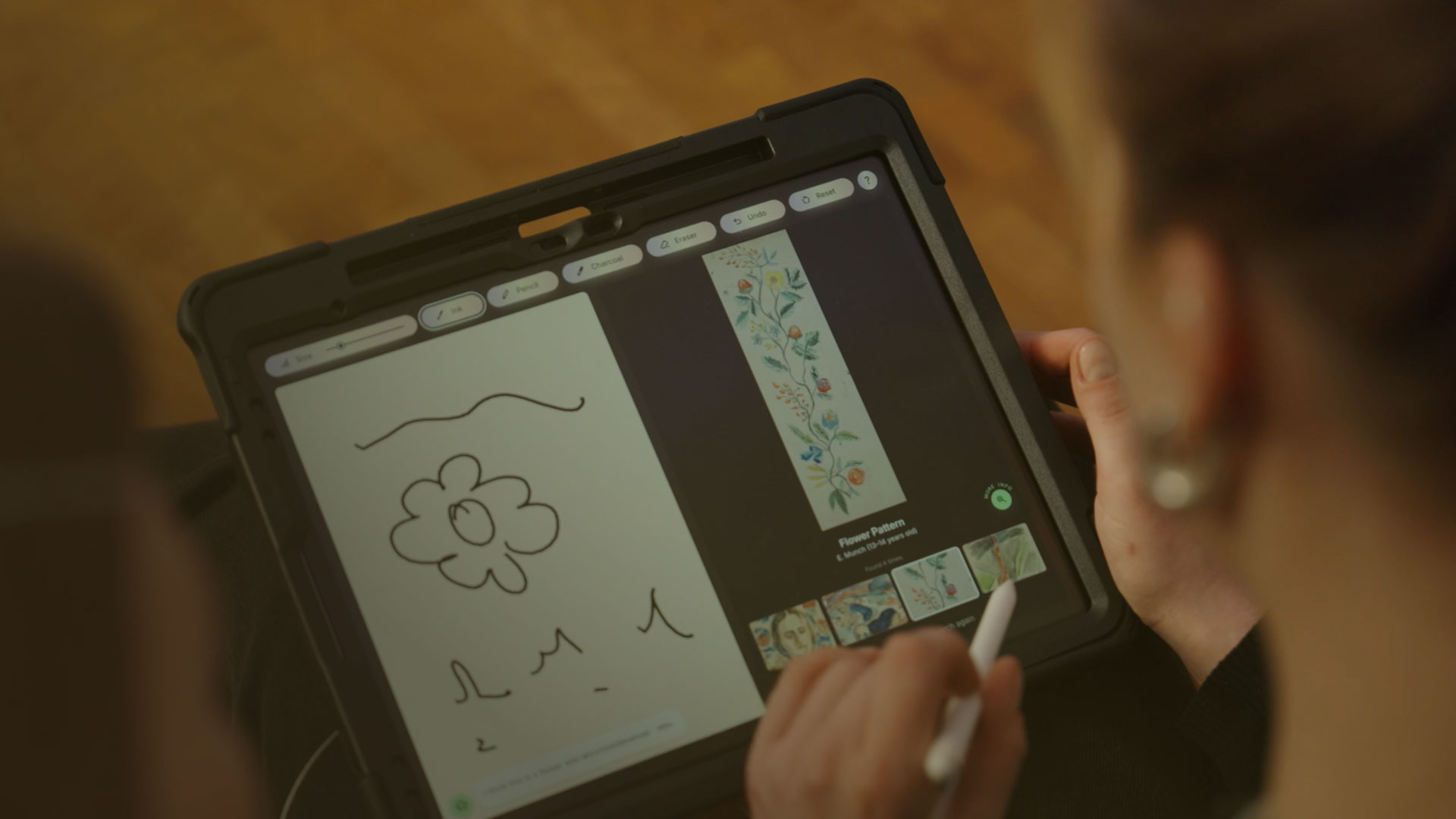
New Snow 1 invited visitors to explore the digital archives of Edvard Munch’s drawings by creating sketches of their own. The process is simple. Once comfortably settled into the Lab space, visitors pick up a tablet and commence doodling. Vision language models analyse the sketches and find the most suitable image that matches their drawing to a similar piece from Munch’s collection. Lightweight and efficient AI models process drawings swiftly and securely — without demanding heavy computational power or storage. Importantly, visitors’ drawings are kept private — they are neither stored nor used to train the AI.
Building on the success of New Snow 1, TCS and MUNCH launched New Snow 2 in August 2025, further elevating the art experience for museum visitors through the adoption of advanced AI models and technical enhancements. New Snow 2 significantly improved the retrieval quality of Munch’s sketches, enhancing both relevance and diversity of results, making the experience more intuitive. It now uses a SOTA vision-language model for sharper matches and a refined sampling algorithm to broaden diversity across texture, colour, and shading. Searches can even be refined by specifying the colour and drawing tool used, creating a truly personalised experience.
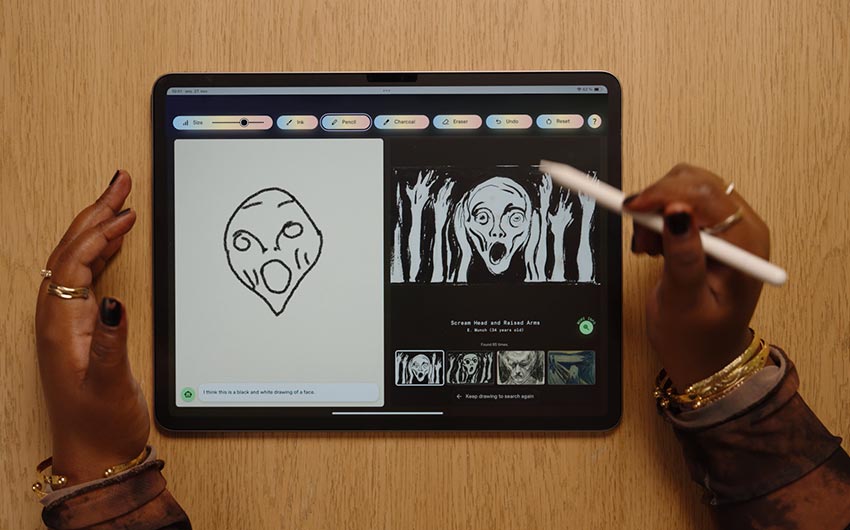
In addition, New Snow 2 incorporates catalogue raisonné information from the museum’s collection management system. The catalogue raisonné provides authoritative scholarly metadata for Munch’s sketches, documenting their motifs, provenance, relationships, and art-historical context. Visitors’ sketches are captioned and embedded — as in New Snow 1 — and then matched to catalogue raisonné entries embedded in Munch’s sketches with greater precision. Similarity scores are computed and ranked to deliver the most meaningful and varied results.
This unique partnership between TCS and MUNCH Museum demonstrates how advanced technology can enhance access to art, grounded in shared values and ethical standards.
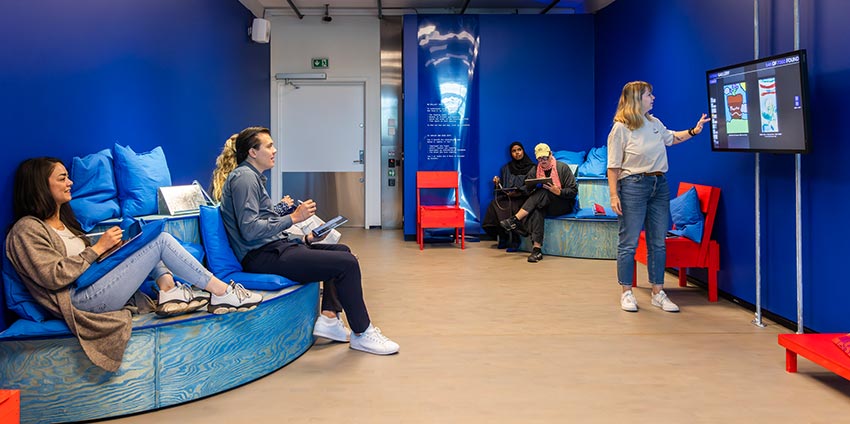
As part of the collaboration, an interactive showcase based on Edvard Munch's drawings and the New Snow participatory drawing experience, will be presented in the museum's unique exhibition room on the 10th floor, opening in June 2026.
Impact
- Average time spent viewing a single artwork in museums/galleries: 26 seconds
- Average time spent per user interaction in New Snow (including sketching and reflecting on Munch’s sketches): ≈102 seconds → nearly 4× longer engagement than traditional artwork viewing
New Snow 1 (NYSNØ 1)
- Duration: 82 days
- Audience drawings submitted: 59,379
- Average daily drawings: 724
- Munch drawings in dataset: 3,807
- Unique Munch drawings identified: 1,814
- Munch drawings not shown/found: 1,993
New Snow 2 (NYSNØ 2)
- Duration: 37 days
- Audience drawings submitted: 21,230
- Munch drawings in dataset: 7,410 (nearly double NYSNØ 1)
- Unique Munch drawings identified: 2,996 (+65% compared to NYSNØ 1)
- New Munch drawings found and shown in New Snow 2: 2,132
New Snow Gallery (timeline installation)
- Audience drawings submitted: 6,687 (31.5% of all New Snow 2 drawings)
- Unique Munch drawings shown in timeline: 1,262
- Average daily drawings: 573
Key takeaways
- New Snow substantially extends visitor engagement time
- New Snow 2 uniquely expands the discoverability of Munch’s drawings in unprecedented ways
- This collaboration makes thousands of previously unseen works accessible through AI and public participation
- Audience drawing becomes an active tool for engagement, collection exploration and knowledge production
- Sharmistha Choudhury