March 2026 | 1716 words | 7-minute read


Tata Power leads the battery storage charge
Tata Power’s April 2025 winning bid to install a 100MW battery energy storage system (BESS) in Mumbai marks a pivotal moment in India’s energy transition. With India targeting 500GW non-fossil capacity by 2030 and a projected $32bn storage market, Tata Power is expanding nationwide, leveraging its integrated model of generation, storage, and distribution. BESS addresses renewable intermittency, reduces curtailment, and supports grid stability. Falling battery costs, government incentives, and local manufacturing are accelerating adoption. Tata Power’s projects in Mumbai, Kerala, and Chhattisgarh, plus innovations like MySine for homes, position it to lead India’s urgent energy storage transformation.
Tata Power leads the battery storage charge
In April 2025, Tata Power’s win of a 100MW battery energy storage system (BESS) bid in Mumbai marked a pivotal moment for India’s energy transition. With India targeting 500GW of non-fossil fuel capacity by 2030, and requiring 61GW of storage, the battery storage market is projected to reach $32 billion.
Tata Power is leveraging its integrated model—spanning generation, storage, and distribution—to lead this sector, with projects in Mumbai, Kerala, Delhi, and Chhattisgarh. The company’s strategy addresses India’s surging energy demand and the intermittency of renewables, which causes daytime oversupply and evening shortages, leading to distress sales and renewable curtailment. BESS mitigates these issues by storing excess daytime energy and releasing it during peak demand, improving reliability, reducing waste, and stabilizing tariffs. India’s National Electricity Plan calls for 236GWh of BESS by 2032, yet only 505.6MWh is operational, presenting a vast opportunity.
Tata Power’s business case for BESS includes energy arbitrage, capacity payments, and grid services. Costs have fallen sharply, making storage more viable. The Mumbai project uses modular, containerized batteries to overcome land constraints, providing operational flexibility and critical system benefits like black-start capability. Tata Power’s multistate strategy includes service-based models, as seen in Kerala, and integrated solar-plus-storage solutions in Chhattisgarh. Vertical integration gives Tata Power an edge, offering bundled renewable and storage solutions. Government incentives and local manufacturing are needed to scale up. Tata Power is advancing innovation, repurposing EV batteries, and launching retail products like MySine, supporting India’s clean energy ambitions.
Tata Power leads the battery storage charge
In April 2025, Tata Power’s successful bid to install a 100MW battery energy storage system (BESS) in Mumbai marked a pivotal moment for India’s energy transition and the company’s strategic evolution. With India aiming for 500GW of non-fossil fuel capacity by 2030—up from 235GW currently—and anticipating a need for 61GW of storage, the energy storage landscape is rapidly expanding. The storage market, virtually non-existent five years ago, is projected to reach $32 billion by 2030. Tata Power is positioning itself as a leader, launching multi-state storage projects in Mumbai and Kerala, leveraging operational experience from Delhi and Chhattisgarh.
India’s energy demand is expected to rise sharply, reaching 366GW by 2030, a 50% increase. Annual additions of 15-25GW of solar and wind capacity present challenges: renewable intermittency, supply-demand mismatches, distress sales, and renewable curtailment. Solar power is abundant and cheap during the day but demand peaks in the evening when solar output drops. This leads to utilities selling surplus power cheaply and curtailment—wasting clean energy when generation exceeds grid capacity. BESS addresses these challenges by storing excess energy and releasing it during peak demand, improving reliability, reducing curtailment, stabilizing tariffs, and benefiting customers.
India’s National Electricity Plan (2023) calls for 236GWh of BESS and 175GWh of pumped hydro storage by 2032. However, as of August 2025, only 505.6MWh of operational battery capacity exists, highlighting an 800x gap and a significant business opportunity. Battery storage is not merely about backup; it enables revenue from energy arbitrage, capacity payments, and grid services such as frequency regulation. Firm renewable energy—bundling generation with storage for round-the-clock (RTC) supply—is increasingly valuable, especially as BESS costs have dropped 40% year-on-year to $165/kWh in 2024 due to cheaper raw materials, manufacturing scale-up, and advances in lithium iron phosphate chemistry.
Tata Power’s Mumbai BESS project showcases urban storage innovation. Modular, containerized batteries will be installed at 10 sites, connecting to the Power System Control Centre. The design reduces land footprint by 30-40%, allows vertical stacking, and improves grid resilience. The system supports black-start capability, frequency regulation, voltage support, and energy arbitrage, storing two hours of peak load and generating revenue from utility bill savings, ancillary services, and deferred infrastructure spending.
Nationally, Tata Power signed a stand-alone Battery Energy Storage Purchase Agreement in Kerala for a 30MW/120MWh BESS, providing four hours of backup power. Unlike Mumbai, this is a service model: Tata Power builds and maintains the system while NHPC pays for capacity. The Kerala project builds on Tata Power’s Chhattisgarh solar-plus-BESS project, which offsets 4.87MT of CO2 emissions and serves as a blueprint for future RTC power contracts.
Tata Power’s vertical integration—generation, transmission, manufacturing, trading, and storage—gives it a competitive edge. Government support is crucial, with allocations for manufacturing and storage, mandates for co-located storage in solar tenders, and waivers on transmission charges. However, India relies heavily on imported battery cells and materials, making a hybrid model of local assembly and imported components practical until domestic capacity scales up.
Innovation drives Tata Power’s strategy, including an Advanced Battery Testing Laboratory and partnerships for second-life battery solutions. The company’s MySine smart storage system empowers homes and businesses to pair rooftop solar with batteries, providing clean, reliable energy


- 0.5×
- 0.75×
- 1×
- 1.25×
- 1.5×


In April 2025, when Tata Power secured a bid to install a 100MW battery energy storage system (BESS) in Mumbai, it signalled more than a portfolio expansion — it marked an inflection point for one of India’s largest integrated power companies and reflected the country’s energy transition ambitions.
With India targeting 500GW of non-fossil fuel capacity by 2030 — up from ~235GW today — and anticipating a requirement of 61GW of storage, the landscape is rapidly evolving into a significant business opportunity. Virtually non-existent just five years ago, the Indian storage market is projected to reach $32 bn by 2030, a space Tata Power is determined to lead.
The company has rolled out a multistate storage push, with projects underway in Mumbai and Kerala, while leveraging learnings from its operational BESS facilities in Delhi and Chhattisgarh. The strategy is anchored in two clear beliefs: India’s renewable energy expansion makes energy storage unavoidable, and that Tata Power’s integrated business model — spanning generation, storage and distribution — offers an edge over stand-alone players.
The storage imperative
India’s energy demand is expected to outstrip the global average for the next two decades, hitting 366GW by 2030, a 50.6% jump from the current 243GW. Generation capacity will double from 437GW to ~900GW by 2030.
As India adds 15-25GW of solar and wind capacity annually, it faces a fundamental problem. “The sun doesn’t always shine, and the wind doesn’t always blow,” says Viddyesh Raje, Head of Business Development (Utility Scale, EPC, Module Sales) and Utility Scale Projects, Tata Power. “Demand surges in the evening just as solar panels go dark. Electricity grid operators used to steady coal power must now manage fluctuating supply from renewables, risking blackouts and grid instability.”
Two issues intensify the challenge: distress sales and renewable curtailment, driven by the intermittency of renewable power and the growing mismatch between supply and demand. “During the day, solar power is abundant and cheap, but demand is low, so utilities are forced to sell at low prices in the absence of storage,” says Dr Nilesh Kane, Chief – Transmission and Mumbai Distribution, Tata Power. “By evening, demand surges to its peak, around 8 pm during non-solar hours, making power expensive for distributors and consumers.”
Dr Kane explains that renewable curtailment “is as good as wasting clean energy”. “Curtailment happens when generation is available, but transmission congestion, balancing limits, or local demand conditions force us to back down renewable output,” he says. “Battery energy storage systems address both challenges: they store excess energy generated during the day and discharge it when demand peaks, supporting peak-load management, reducing curtailment and waste, improving round-the-clock reliability, stabilising tariffs and ultimately benefiting customers.”
The need is urgent. India’s National Electricity Plan (2023) calls for 236GWh of BESS and 175GWh of pumped hydro storage capacity by 2032. As of August 2025, India has just ~505.6MWh — barely half a gigawatt hour — of operational battery capacity. Tata Power sees this 800x gap as a business opportunity. Scaling battery adoption is crucial to balance renewable generation and deliver cheaper, round-the-clock (RTC) green power.
The business case
Battery storage isn’t just about backup and reliability. It is a revenue engine — from energy arbitrage (operators buy energy when it’s low and sell when it is high) to capacity payments (for being available during peak demand) and grid services, like frequency regulation to keep the grid stable. “More valuable is ‘firm renewable energy’, when generation is bundled with storage to guarantee RTC supply,” explains Mr Raje.
The potential is even more compelling with the improving economics. BESS pricing has experienced a notable decline since 2023, driven by falling raw material costs alongside rapid manufacturing scale-up, technological advancements, and a shift towards cost-efficient chemistries such as lithium iron phosphate. BESS costs fell 40% year-on-year to achieve a record low of $165/kWh in 2024.
Smart design for urban energy
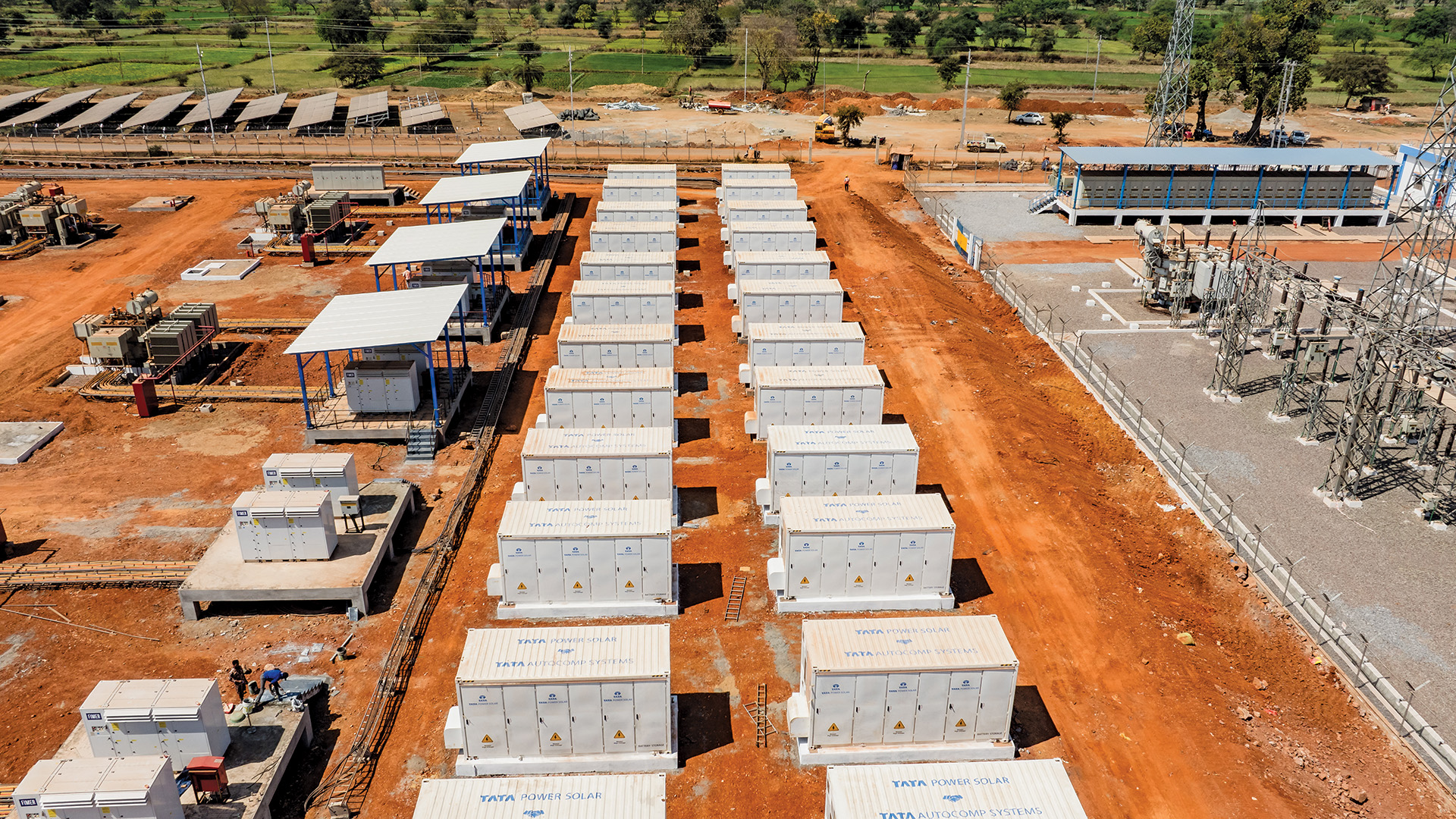
Tata Power’s 100MW BESS in Mumbai illustrates the promise and complexity of deploying storage. Over two years, modular, containerised batteries from Tata AutoComp Systems will be installed across 10 strategic sites. Units ranging from 20ft containers with 5MWh storage to larger 10-20MWh containers will all connect to the company’s Power System Control Centre — the city’s digital nervous system for load dispatch since 1950.
Given Mumbai’s severe land constraints and high real-estate costs, Tata Power has chosen a containerised battery energy storage design that reduces footprint requirements by 30–40%, says Dr Kane. The modular containers can also be stacked vertically to add capacity, and their proximity to load centres improves both operational efficiency and grid resilience.
Beyond day-to-day flexibility, the project provides critical system benefits, including a black-start capability that can rapidly restore power to essential services such as hospitals, metro networks, and airports. “The battery can act as a source and sink, with ramp up and ramp down capability of 100MW in a minute,” says Dr Kane.
The system also enables frequency regulation, voltage support, and energy arbitrage by storing two hours of peak load (~100-150MW), thereby reducing costs. Revenue will flow from utility bill savings (as it owns the distribution business), payments for ancillary services, and deferred spending on infrastructure as batteries can delay costly substation upgrades.
Multistate strategy
Tata Power has been scaling its storage ambitions nationwide. In July 2025, it signed its first stand-alone Battery Energy Storage Purchase Agreement with NHPC for Kerala State Electricity Board to install a 30MW/120MWh BESS at Areacode substation, providing four hours of backup power.
The deal reveals an evolving business model. Unlike the Mumbai project, where it owns both assets and distribution, the Kerala deal is a service model. Tata Power will build and maintain the system, while NHPC pays for the capacity.
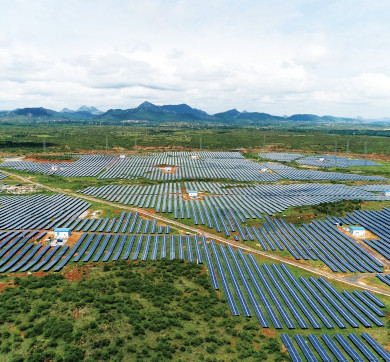
The Kerala project builds on Tata Power’s successful delivery of India’s largest solar-plus-BESS project in Chhattisgarh in 2024. The ₹945 crore project, built for the Solar Energy Corporation of India, has a 100MW solar plant and a 120MWh BESS. The plant generates ~243.53mn units annually and will offset 4.87MT of CO2 emissions over 25 years, serving as a blueprint for future projects.
“The Chhattisgarh project gave us insights across the value chain and project life cycle,” says Mr Raje. “We have since won three interesting contracts integrating solar, wind, and storage for RTC power, which will be operational by 2026.”
One-stop energy solution
Unlike pure-play storage developers, Tata Power has an end-to-end capability that gives it an edge. As of Q2 FY26, it has ~26.3GW of generation capacity spanning renewable and conventional, 4,659Ckm of transmission lines serving 1.3 crore customers, ~4.9GW solar manufacturing capacity, trading operations and three storage projects in operation.
This vertical integration enables Tata Power to deliver the complete package: renewable generation, battery storage, and RTC energy with no carbon footprint. For electricity boards that have mandated Renewable Purchase Obligations and Energy Storage Obligations, such bundled services simplify procurement.
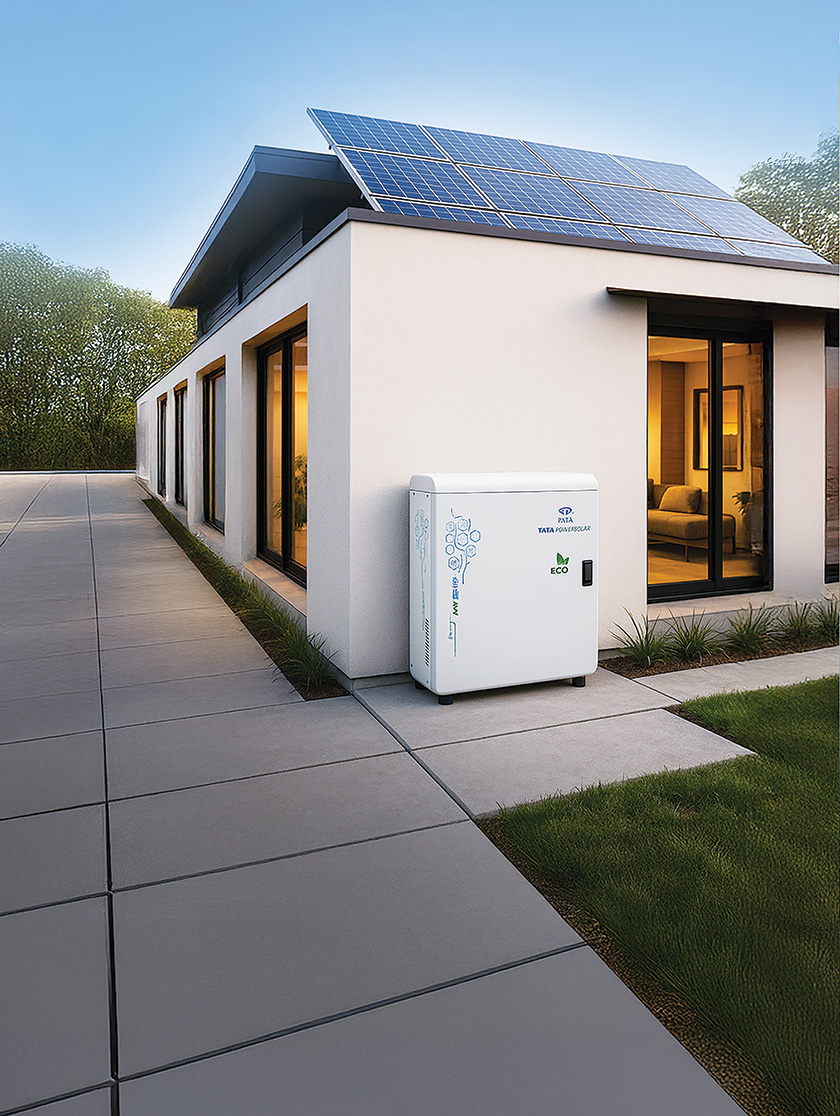
Solar + storage for homes
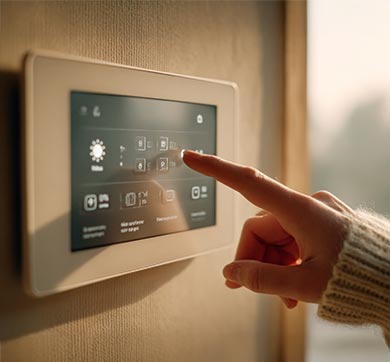
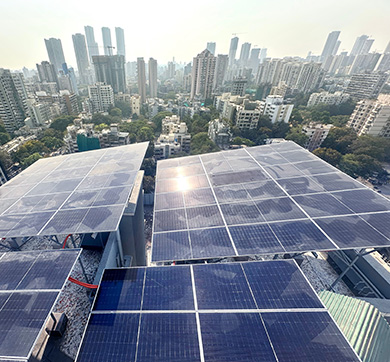
Recently, Tata Power launched MySine, a smart energy storage system for its retail customers. “Homes and small businesses can pair their rooftop solar with the MySine battery to store excess energy during the day,” says Mr Raje. “They can then use it during outages or peak demand, reducing dependence on the grid and cutting costs.”
Powered by lithium iron phosphate batteries, MySine charges in two to three hours, lasts 10+ years with 6,000+ charge cycles, and kicks in within 10msec during power outages, providing clean energy 24×7.
Pragmatic approach
Strong government policy and funding support are vital for a nascent industry. So far, the Indian government has allocated Rs 18,100 crore for advanced chemistry cell manufacturing, Rs 3,760 crore for 4GWh storage, and Rs 5,400 crore for 30GWh stand-alone battery systems. The Power Ministry has also mandated co-located energy storage in future solar tenders and the waiver of inter-state transmission charges for co-located projects.
Tata Power notes that the market still depends on foreign OEMs for manufacturing — importing over 80% of battery cells — and raw materials as India’s supply chains and recycling remain limited. This increases forex risks, logistical bottlenecks, and sustainability concerns. The company believes that until local capacity scales up, India will continue to rely on imported critical materials, like lithium, cobalt, nickel, and graphite, making a hybrid model — importing cells and battery management systems (BMS), with local assembly of racks, energy management systems, and containers — the practical near-term solution.
To achieve 400GWh by 2030, the company stresses the need for stronger government incentives across the manufacturing value chain and R&D support for new chemistries, like sodium-ion and flow batteries, which are vital to building a resilient, scalable, and future-ready ecosystem.
Driving synergies
While policy support is vital, Tata Power is advancing innovation through an Advanced Battery Testing Laboratory in Delhi and partnerships with Tata AutoComp Systems for manufacturing stationary BESS and developing a BMS.
Tata Power works closely with other Group companies to research and develop second-life battery solutions. “EV batteries still retain around 30-40% of their original storage capacity at the end of their automotive life,” says Dr Kane. “That means they can be repurposed into stationary, second-life battery systems.” This can reduce reliance on new batteries and open additional energy-storage applications, helping address select market needs through cost-effective second-life solutions.
Recent developments have shown that Tata Consultancy Services (TCS) is poised to become a key customer as it sets up energy-intensive data centres powered by Tata Power’s renewable energy. These partnerships, along with Tata Power’s storage ambitions, advance Aalingana — the Tata Group sustainability vision — while fostering synergies across the conglomerate.
Powering the change
Energy storage is no longer optional — it is essential for India’s energy transition. It is the bridge between traditional coal-based generation and clean, reliable energy, and underpins grid stability and India’s 500GW renewable target.
With end-to-end capabilities, early-mover positioning, and a deep understanding of the market, Tata Power is uniquely positioned to lead this critical infrastructure transformation in Asia’s third-largest economy.
— Kermin Bhot